

Kategorien
Nordic Tattoo

Handpoke Tattooing – Modern and Traditional Handpoke Technique

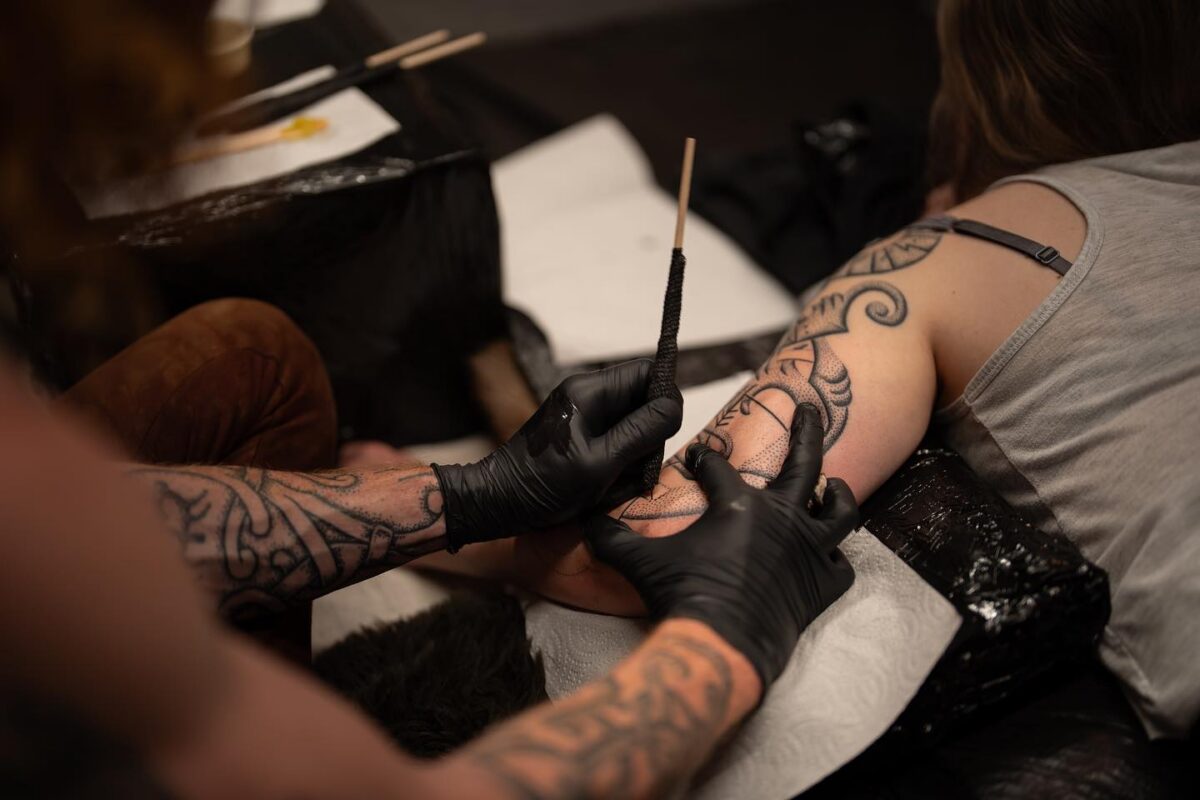
Tattooing without a machine is not a modern alternative to machine tattooing. It is, in fact, one of the oldest methods of permanently marking the skin. Long before the invention of the electric tattoo machine, tattoos were created entirely by hand. Across different cultures and periods, a wide variety of tools were used for this purpose, including thorns, sharpened bone, wood, and other natural materials. Although these methods differed considerably, they shared the same fundamental principle. The pigment was introduced into the skin through a series of deliberate, individual dots.
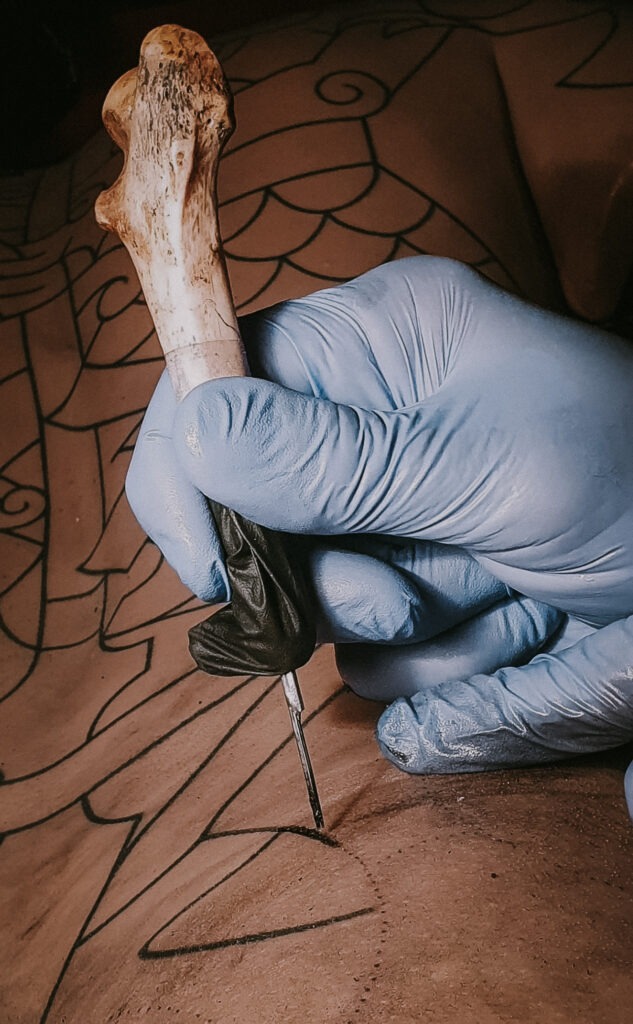
© Picture by Colin Dale | Skin & Bone Tattoo Shop in Copenhagen, Denmark
Colin Dale | Skin & Bone Tattoo Shop in Copenhagen, Denmark

Modern handpoke tattooing follows this same basic principle while using contemporary materials and professional standards. Sterile tattoo needles and professional tattoo pigments are used, just as they may be in machine tattooing. The fundamental difference is therefore not necessarily the needle or the pigment, but the way in which the needle is operated and the pigment is deposited into the skin.

In handpoke tattooing, the needle is guided entirely by hand, without the use of an electric tattoo machine. Each dot I do is made individually, introducing a small amount of pigment into the skin. Only as much as needed to create the picture. Through the accumulation of these individual points, lines, textures, and solid areas are gradually formed into the finished tattoo. The process is slow, deliberate, and highly tactile and even meditating. Every single dot is placed consciously and has its purpose.
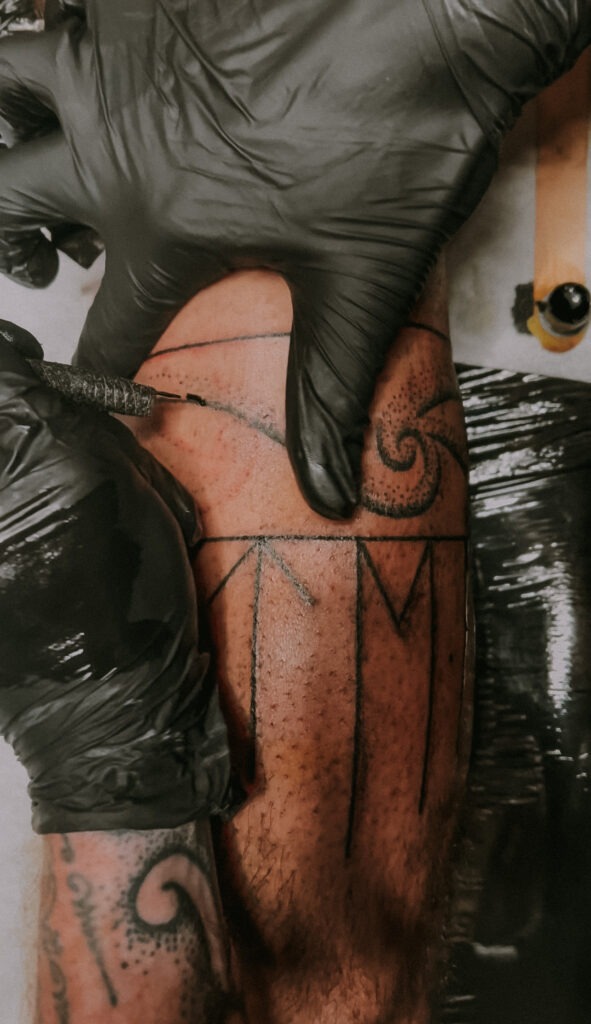
Ancientskin Handpoke Tattooing

Machine tattooing, by contrast, uses a mechanically driven needle that moves rapidly in and out of the skin. Depending on the machine, its configuration, and the technique being used, the needle may move at a very high frequency, allowing hundreds of individual punctures to be made within a short period of time. In handpoke tattooing, there is no continuous mechanical movement. The rhythm of the work is instead determined entirely by the hand of the tattooer.

This difference creates a distinct working process. Handpoke tattoos can require more time to complete, particularly when working with larger or highly detailed designs. At the same time, the slower pace allows the tattooer to directly control every individual puncture, including its placement, angle, depth, and spacing. For many practitioners, this direct relationship between hand, needle, and skin is an essential part of the craft.

The way the skin is treated can also differ. Because handpoke tattooing does not involve a rapidly oscillating needle moving continuously across the same area, the mechanical stress placed on the skin can, when performed correctly, be comparatively limited. This should not be understood to mean that handpoke tattooing is painless or inherently gentler in every situation. The condition of the skin after a tattoo depends on many factors, including needle choice, technique, depth, pressure, the number of passes over an area, the design itself, and the individual’s skin. Professional tattooing therefore requires careful technique and a thorough understanding of how the skin responds and heals, regardless of the method used.

Historically, handpoke tattooing is perhaps better understood not as an alternative to tattooing, but as a continuation of one of its original forms. The materials, hygiene practices, and tools used today are fundamentally different from those available to tattooers centuries or millennia ago. The underlying principle, however, remains similar, because the pigment is placed into the skin through repeated, controlled punctures made by hand.

The term “stick and poke” is sometimes used informally to describe this method. While widely understood, it is a more casual and negative expression and does not fully reflect the craftsmanship, respect or historical depth of the practice. Terms such as “handpoke,” “hand-poked tattooing,” or “machine-free tattooing” more accurately describe the technique itself.

Handpoke tattooing is not machine tattooing performed at a slower speed. It is a distinct way of working in which the entire process is governed by the movement of the hand. Every dot, line, and passage of pigment is created individually. The slower rhythm becomes part of the method itself, connecting contemporary tattoo practice with a tradition that predates the electric tattoo machine by thousands of years.

Modern handpoke tattooing combines an ancient principle with contemporary materials, knowledge, and hygiene standards.
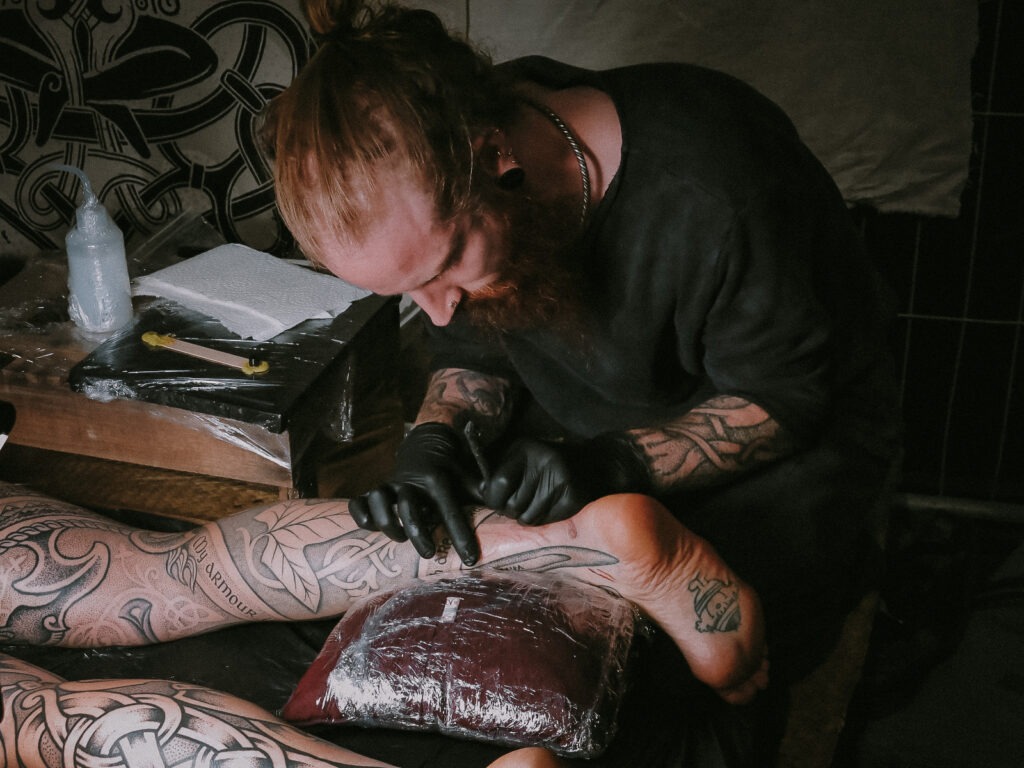
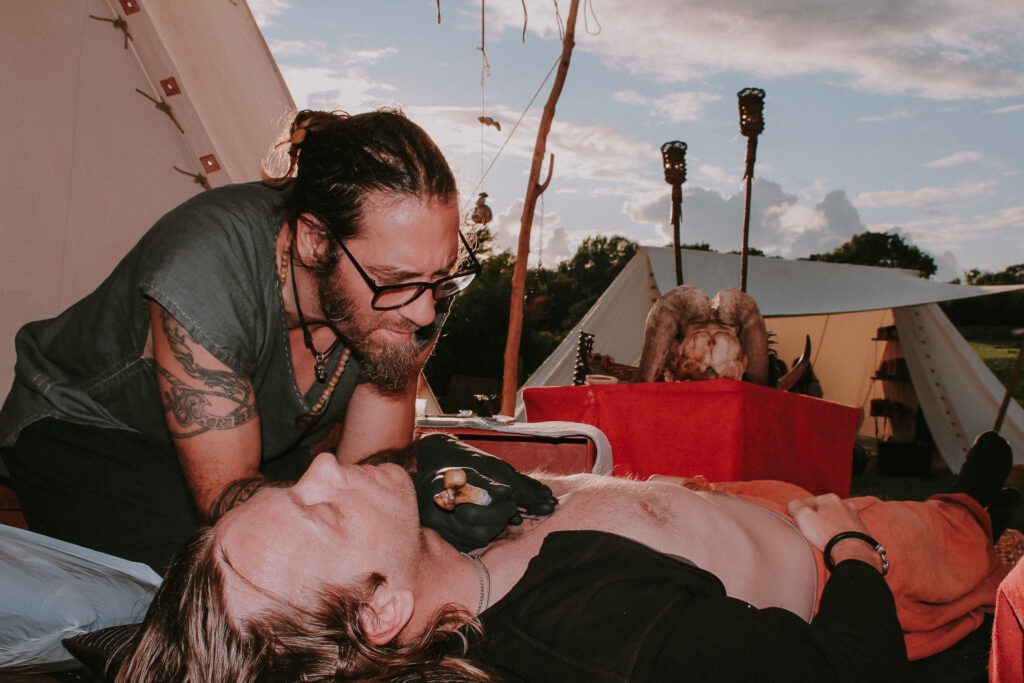
Nordic & Historical Handpoke Tattooing
Colin Dale | Skin & Bone Tattoo Shop in Copenhagen, Denmark

This is Colin Dale | Skin & Bone tattooing on the Historical Market in Copenhagen.
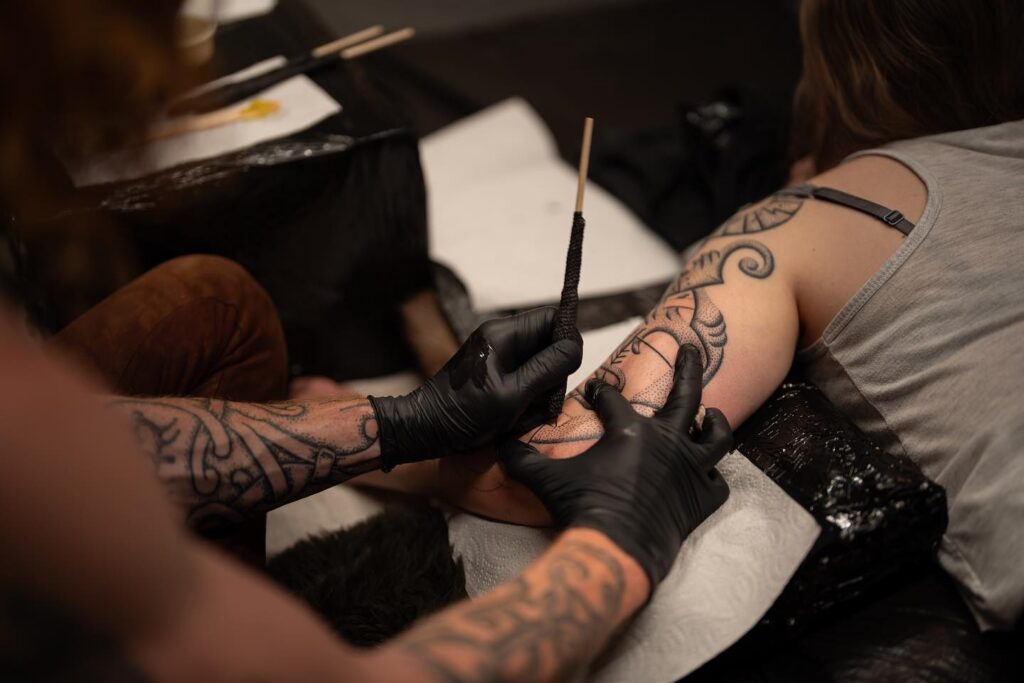
Ancientskin-Handpoke-Nordic-and-historical-tattooing
Picture © Aron Lux
Kategorien
Norse History Hub

The Viking Tattoo

Did Vikings have Tattoos?

There is some evidence that Vikings may have had tattoos, although there is no archaeological proof that can confirm how common they were. One of the most important written sources is the account of Ahmad ibn Fadlan, an Arab traveler who encountered a group of Rus people in the early 10th century.

Ibn Fadlan described these people as being tall and having designs covering their bodies. He compared the markings to trees and other images and said they extended from their fingertips up toward their necks. Because the Rus were Scandinavian traders and warriors who traveled through Eastern Europe, this description is often used as evidence that at least some Vikings may have practiced tattooing.

However, Ibn Fadlan did not specifically call these people „Vikings“ and his description does not prove that all Vikings had tattoos. The exact identity of the Rus and the meaning of their body markings are also subjects of historical discussion.

Therefore, the most accurate conclusion is that tattoos among some Viking-age Scandinavians are possible and may be supported by Ibn Fadlan’s account, but there is not enough evidence to say that tattoos were common among all Vikings. When we speak of Viking Age art today, we often do
not think of a specific style, but rather generally of
intertwined bands and animal beings. Although this is
something that almost all Viking Age styles have in common,
from an art-historical perspective, these are several
different stylistic phases.

It is not about copying a historical depiction as accurately
as possible. Such a copy would already be a modern
reconstruction in itself. No artist today can fully bring
back the original perception, the craft environment, or
the cultural context in which these works were created.

We can study the historical forms, understand their
construction, and develop our own visual language from
them. This is exactly what Nordic Tattoo means to me
as well. The work is based on what already exists. On
ornaments in wood and metal, on runestones, on animal
depictions, and on the ways in which lines and forms
developed over centuries. These elements have to be understood
and reassembled. A motif can be historically inspired
without itself being a historical motif.

This essentially also corresponds to the way the art of
that time was created. They too drew upon forms that
were already known and developed them further. Influences
from elsewhere were taken up and adapted to their
own visual world. Because tradition did not mean standing
still, but further development.

A modern Nordic tattoo can therefore never truly be
“Viking Age.” It is created in another time and under
completely different conditions. But it can be created
from the same attitude. Namely, to understand existing
forms and use them to create something new and independent
that carries the old spirit within it and brings it
into the present. Everything we develop from it today is
a modern interpretation.

Kategorien
The History of The Runes

The History About The Runes

Many theories have been proposed about who created the runes. Some of these theories have more supporters than others, but they all share one thing in common: none of them can be proven with complete certainty. No runic inscriptions, as we recognize the runes today, can be dated with certainty to a time before 200 AD.

I choose to follow the theory that the runes were created around 100–200 AD among the Goths or other Germanic tribes living in an area north of the Black Sea. The runes may have been influenced by the Greek and Latin alphabets. There are many arguments that support this theory.

Later, the runes spread throughout central and northern Europe as these tribes migrated. They were used by the Goths, Herulers, Germans, and Frisians in southern and central Europe, as well as by the Angles and Saxons in the west. In the north, they were used by the Norwegian, Swedish, and Danish people, as well as their counterparts in Iceland and Greenland and the Sami of Lapland (northwestern Russia and northern Sweden, Norway, and Finland).

By around 300 AD, the runic alphabet was the only alphabet used in Scandinavia. However, in central Europe, the runes gradually fell out of use because of the growing popularity of the Latin alphabet, which spread along with Christianity.

Runes could be written from left to right or from right to left. They could also be written with the first sentence going from right to left and the second sentence from left to right, a style known as boustphedon. In addition, runes were sometimes written as a mirror image („venderuner“), upside down („stupruner“), or joined together („bindrunes“), such as the Norwegian Æ (A+E).

A single rune could also represent two runes. For example, the rune „FE“ could represent „FE + FE“. Runes were often written as one continuous line of text, without spaces between words or sentences. If the rune master wanted to separate words or sentences, he used a symbol similar to the letter X, or one, two, or three dots placed above one another. For example, when using two dots, he might write: „I:MAKE:SPACE:WITH:TWO:POINTS“.

There were no lowercase runes; only uppercase runes existed. There were also no strict limits on the format in which runes could be written. They could be written in many different directions and on almost any type of common material. They could be used as beautiful decorations or as hidden magical formulas.

When runes were carved into stone, the rune master created the lines by carving many individual points close together until a complete line was formed.

Four other theories about the runes

1) The Crete Theory

According to the first theory, the runes were introduced to Scandinavia during the same period when the well-known spiral ornaments were introduced from Crete, approximately 1800–400 BC. This theory suggests that the Goths were already familiar with the art of runes before they left Scandinavia, sometime between 200 BC and 200 AD. However, this theory is not as widely accepted.

2) Kjell Aartun’s Theory

Kjell Aartun is a doctor of philosophy and language researcher. In his book RUNER i kulturhistorisk sammenheng, En fruktbarhetskultisk tradisjon (Pax Forlag, Oslo 1994), he writes that he has proven that the runes were not inspired by the Greek and Latin alphabets.

Instead, he argues that the opposite is true. According to his theory, the Norwegian runes are identical to runes that were used in Semitic language areas, such as Trojan Asia Minor and Canaan (Palestine), as far back as 2000 BC.

In Aartun’s view, the runes were one of several oriental writing systems that formed the basic foundation from which the Greek and Latin alphabets later developed. He also writes that he can prove that the earliest Norwegian runic inscriptions were written in a Semitic language. He refers to known cult-based erotic texts, many of which contained sacred depictions of the act of making love.

According to Aartun, new archaeological discoveries show that many people from the Mediterranean region, especially the Cretans (who were Semitic), frequently traveled north on trading journeys. He argues that during the Migration Period, many Semitic-speaking people came to Norway.

Aartun writes that this conclusion is supported by actual facts referred to by Snorri when he says: „these Asians was called aeser(…) in the northern countries the Asians spread so much that their language was the common language in all these countries.“

Kjell Aartun’s theories are not accepted by authoritative Norwegian rune-ologists. However, his theory does have supporters, including some on the Internet site about Blekinge’s Most Ancient Runic Inscriptions.

3) Turgay Kürüm’s Theory

Turgay Kürüm of Turkey writes on his webpage that the purpose of his article is to draw readers‘ attention to the idea that the Futhark alphabet has the very same origin as the ancient Turkish inscriptions of the Gokturk alphabet.

4) The South-Scandinavian Theory

The fourth theory states that the runes created in South Scandinavia during the 300s AD were inspired by the Latin alphabet, but were adapted to a Scandinavian cultural context.

South Scandinavia was a center of runic activity in ancient times.