Categories
Nordic Tattoo

Baldr’s Death – A further step towards Ragnarok

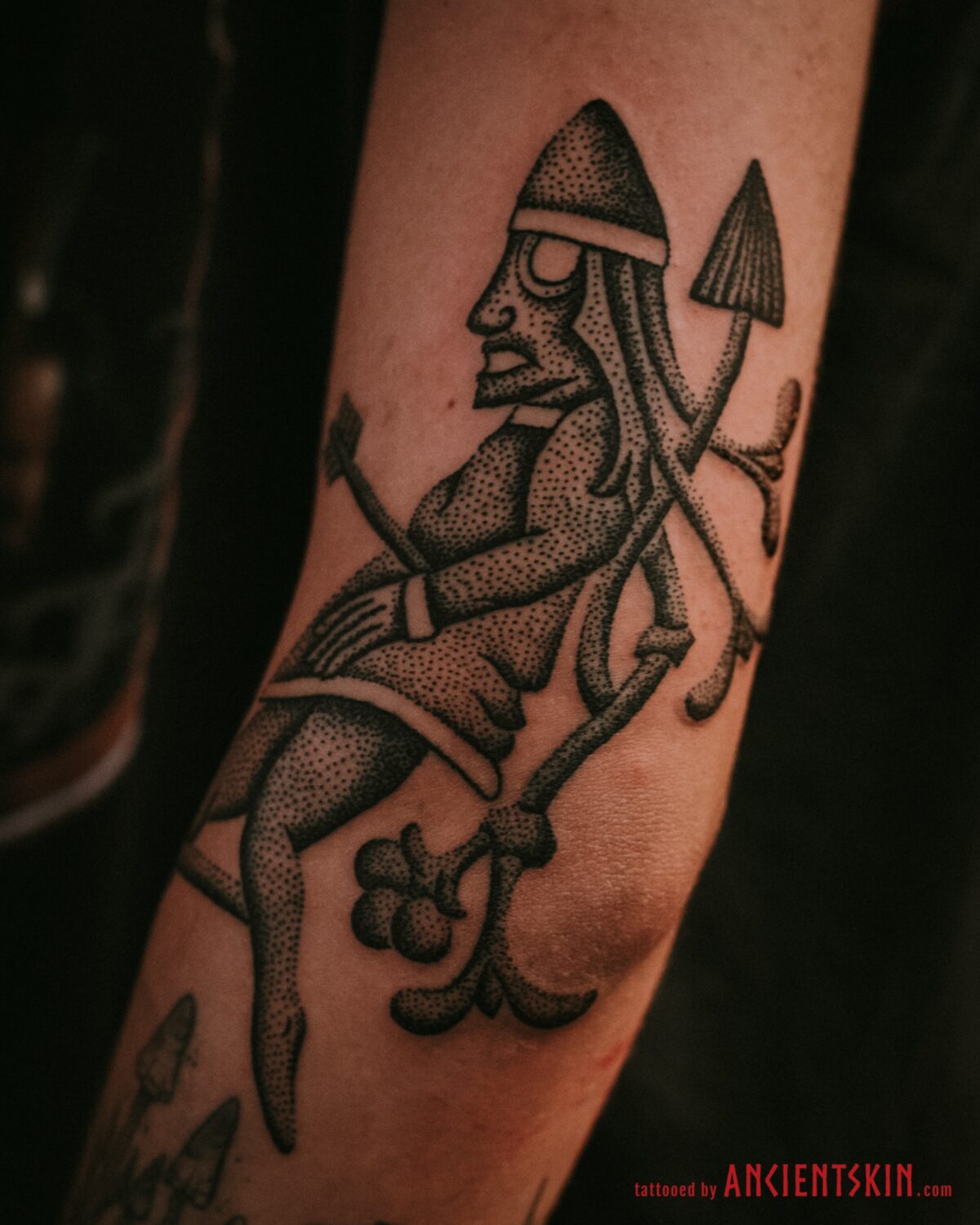
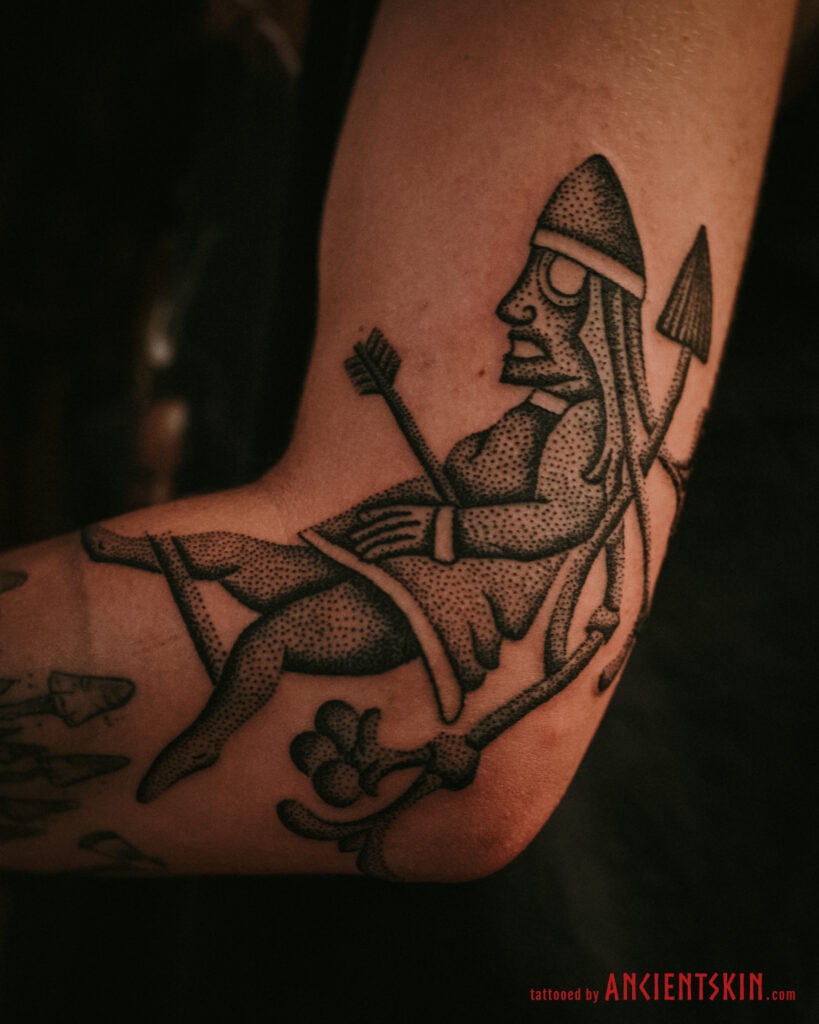
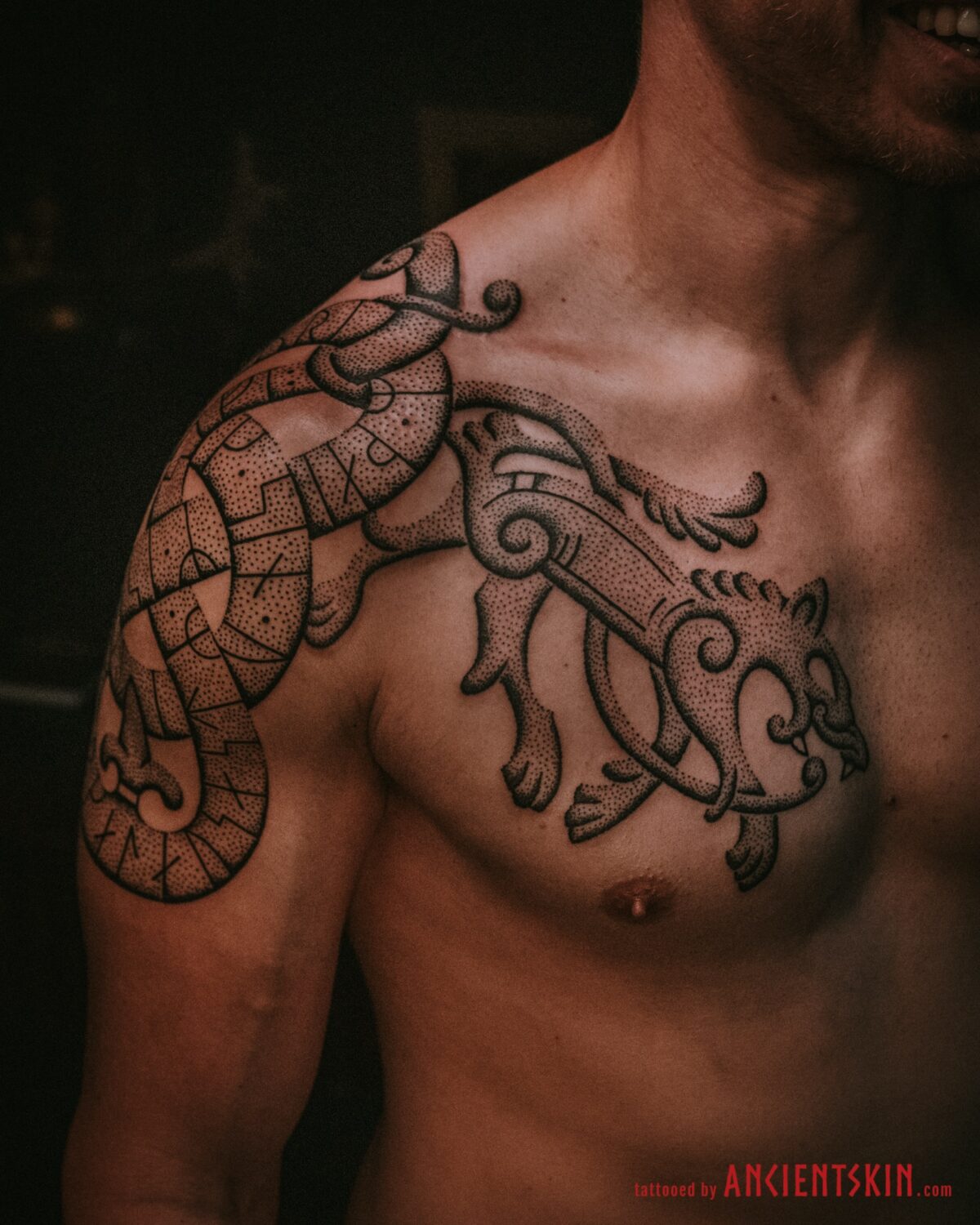
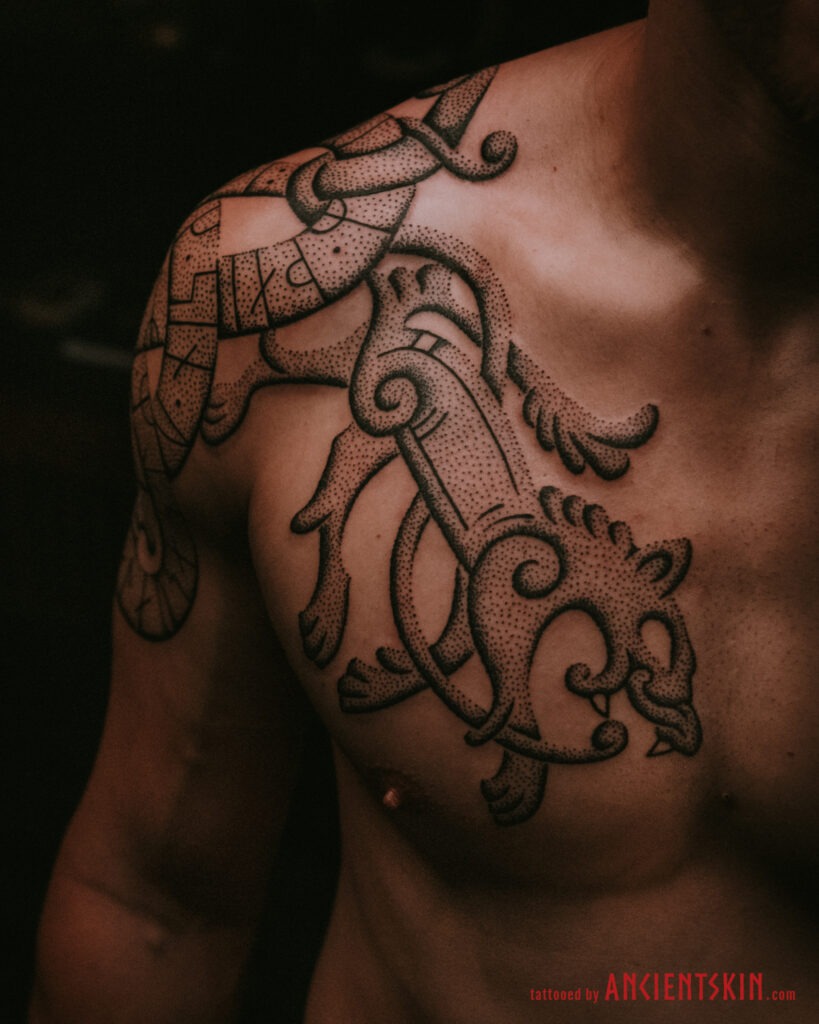
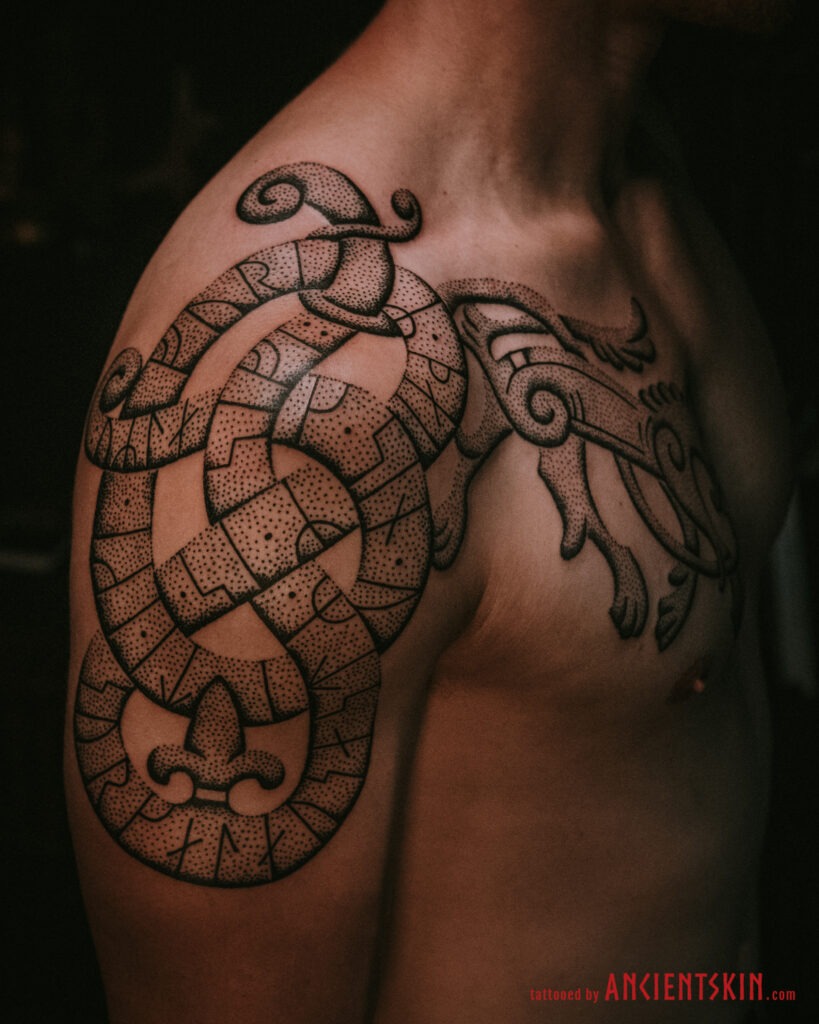
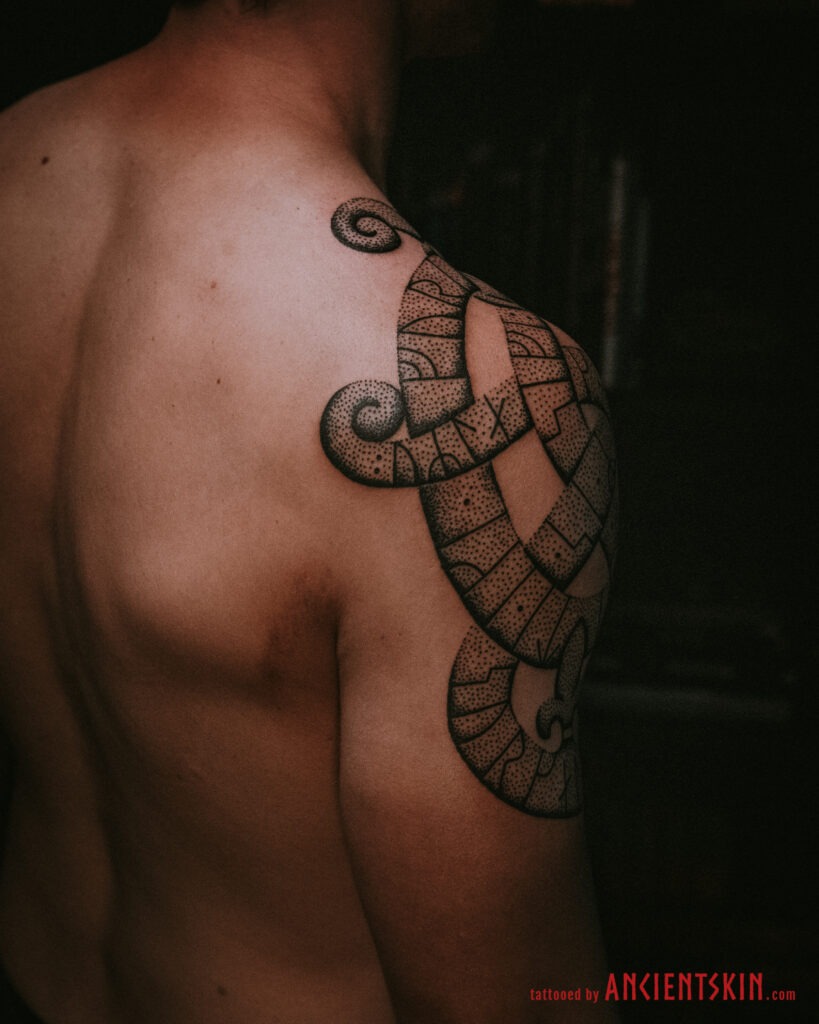
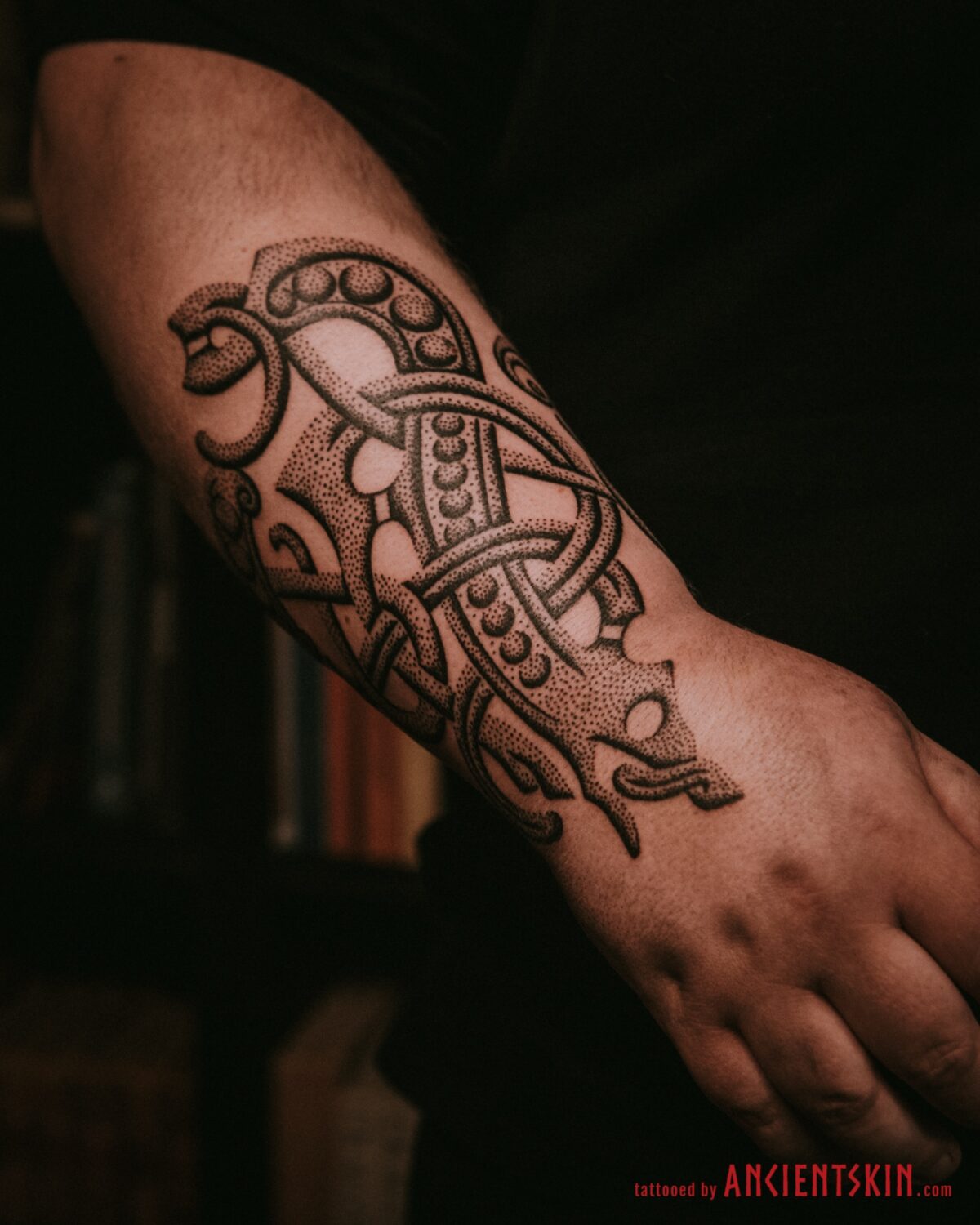
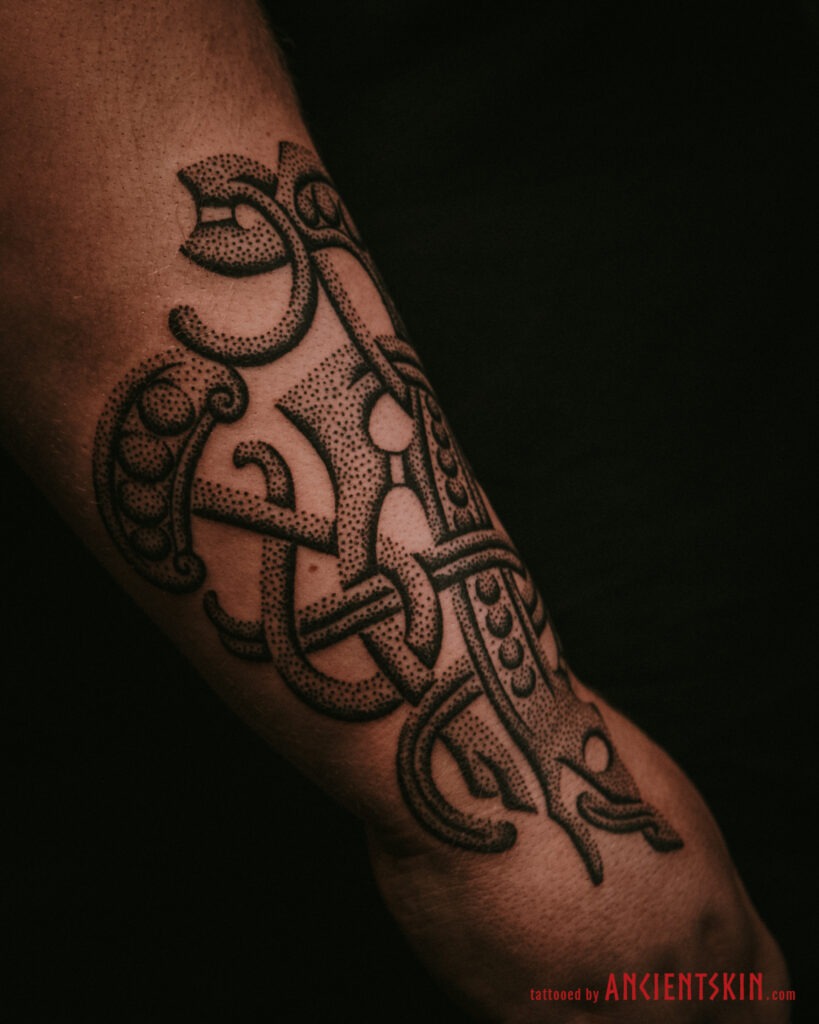
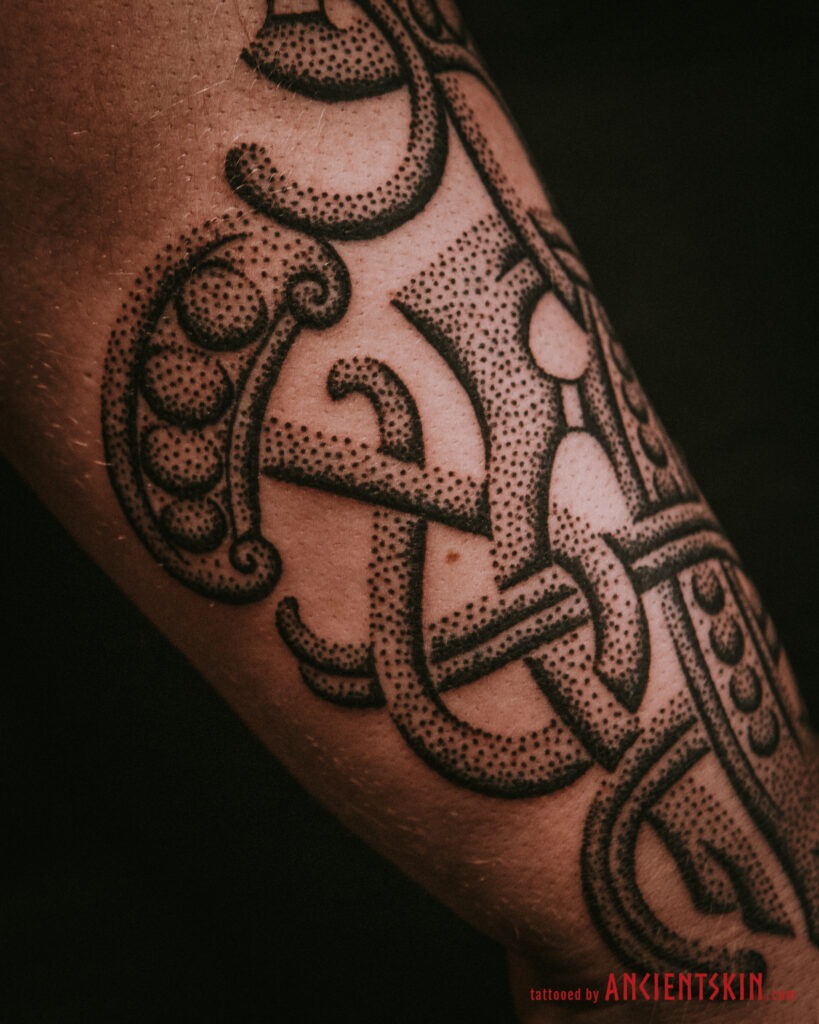
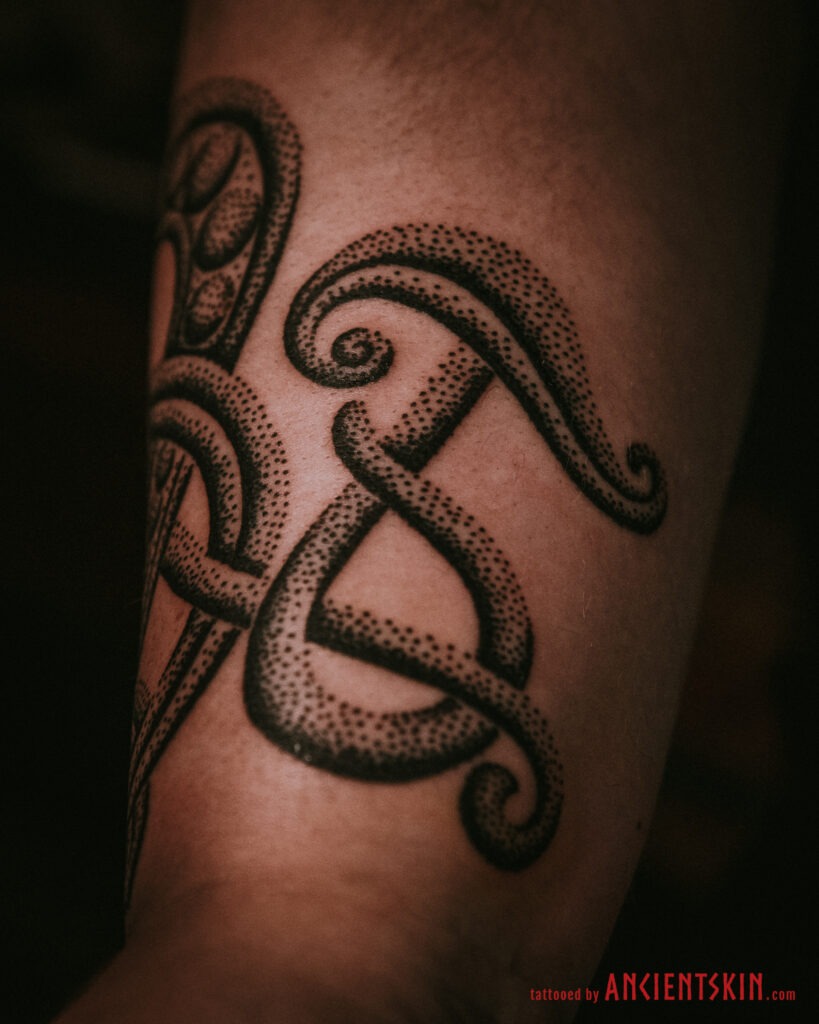
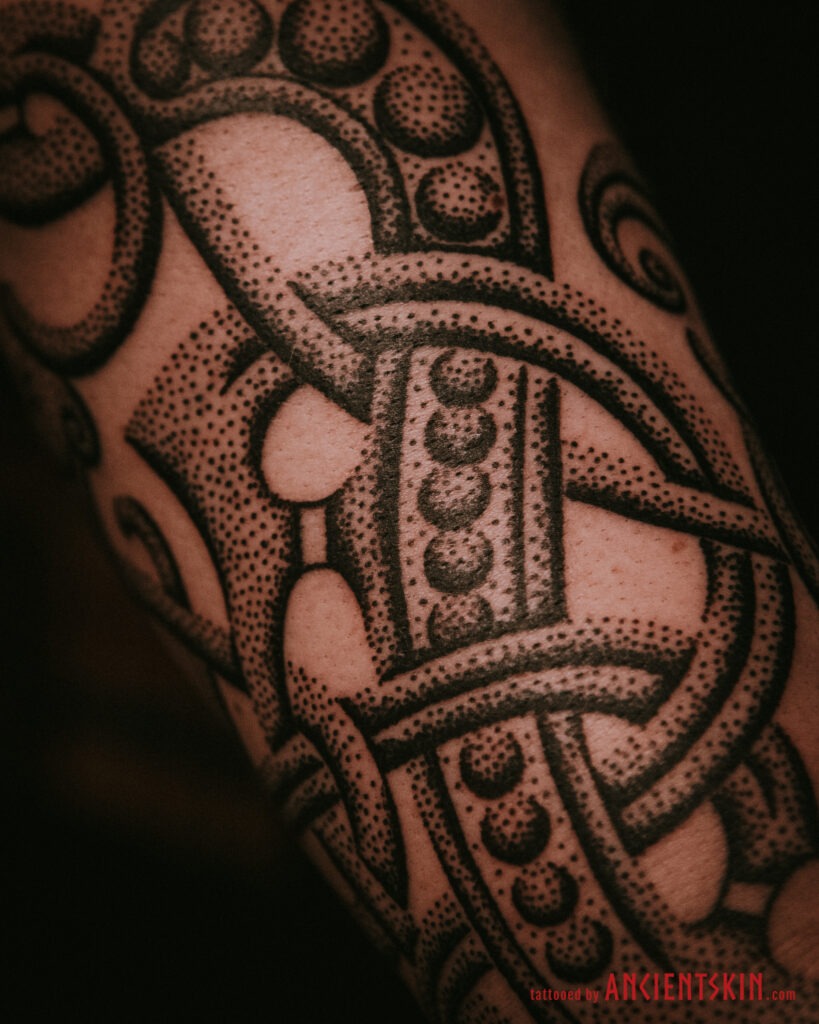
This tattoo pictures Baldr’s death, a further step towards Ragnarok. Baldur’s death serves as the primary catalyst and first major sign of the events leading directly to Ragnarök in Norse mythology. (Baldr is the name in Old Norse language)

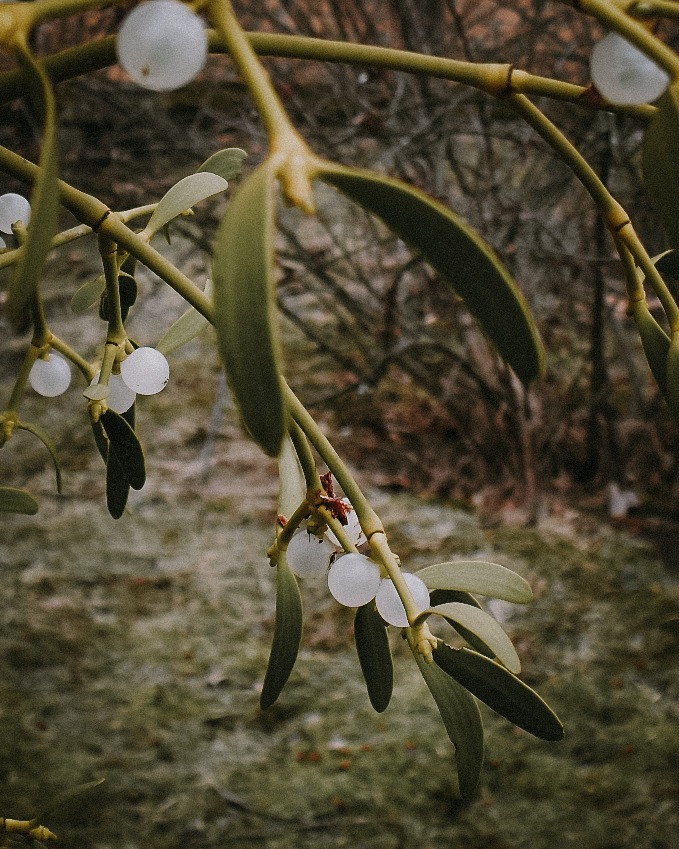
The beloved god of light and son of Odin and Frigg, had nightmares about his own death. Frigg extracted an oath from every living and inanimate thing in existence promising never to harm Baldur, but except for the mistletoe, which she deemed too small and harmless to bother asking. The trickster god Loki discovered this single weakness. He fashioned a dart or spear from Mistletoe and tricked Baldur’s blind brother, Höðr, into throwing it at Baldur, killing him instantly.

Odin sent Hermðr to the underworld (Hel) to plead for Baldur’s return. Hel agreed to release him only if every single thing in the world wept for him. Disguised as a giantess named Þökk (Thökk), Loki refused to cry, leaving Baldur trapped in the underworld. The gods recognized Baldur’s death as the point of no return.

It directly sets off the breakdown of the worlds order and we all experience right now what happens if the order is shattered. But the potential in creating something new after a certain event of death is high.

Ancientskin | Norse & Historical Tattoos | Specialized in Handpoke Tattoos but I also do Machine tattoos. Based in Svenljunga, Västra Götaland, Sweden.

Misteltoe Picture: ©Tubifex Creative Commons CC-BY-SA-3.0

norsetattoo #vikingart #norsemythology #handpoketattoo #historicaltattoo

Categories
Nordic Tattoo

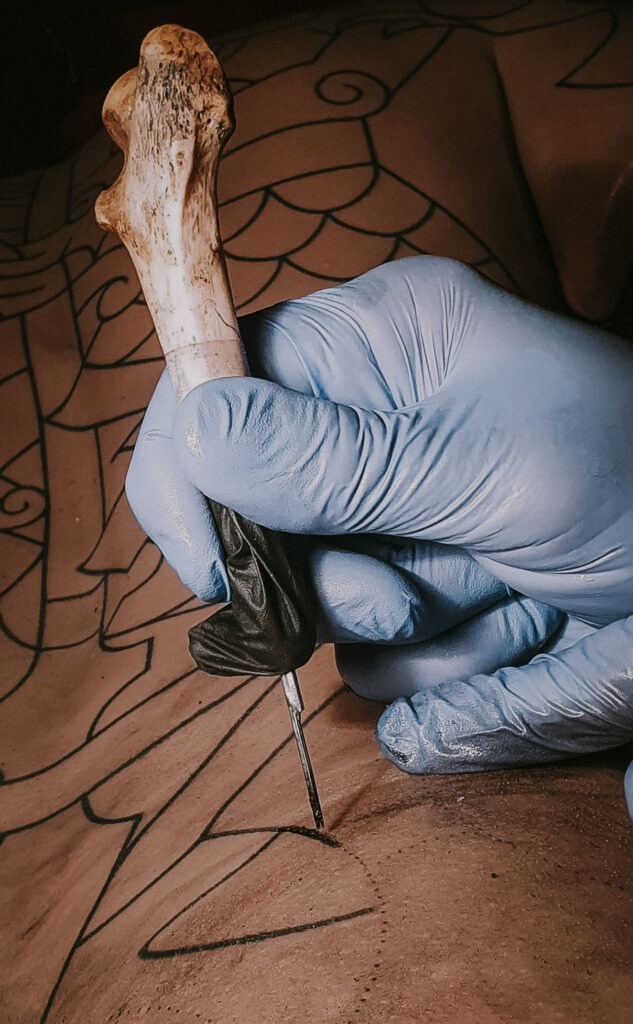
Handpoke Tattooing – Modern and Traditional Handpoke Technique

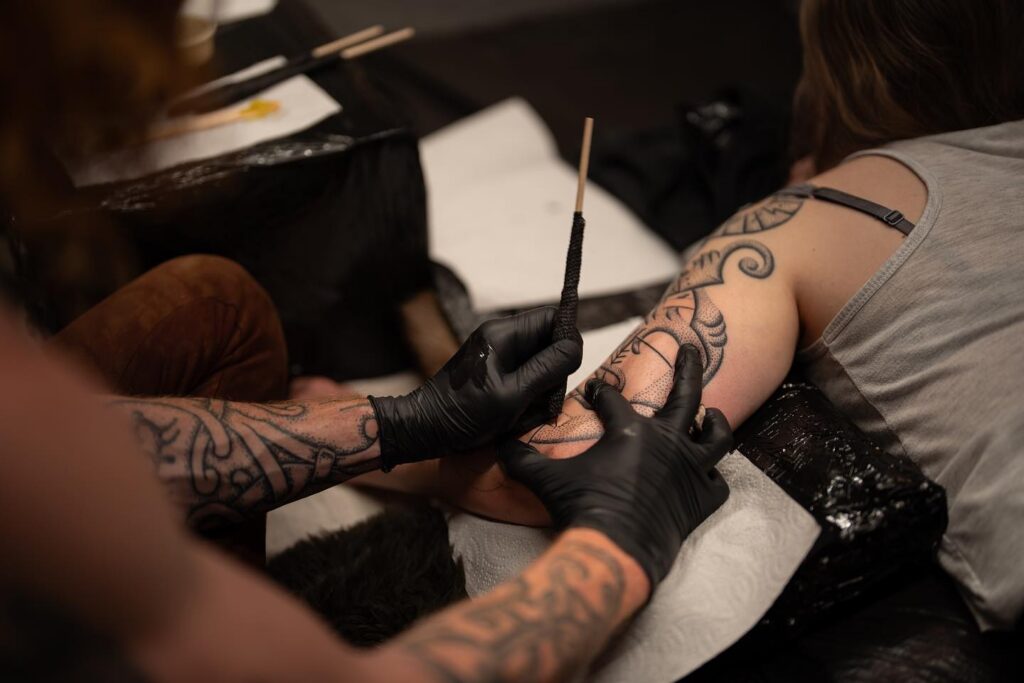
Tattooing without a machine is not a modern alternative to machine tattooing. It is, in fact, one of the oldest methods of permanently marking the skin. Long before the invention of the electric tattoo machine, tattoos were created entirely by hand. Across different cultures and periods, a wide variety of tools were used for this purpose, including thorns, sharpened bone, wood, and other natural materials. Although these methods differed considerably, they shared the same fundamental principle. The pigment was introduced into the skin through a series of deliberate, individual dots.

© Picture by Colin Dale | Skin & Bone Tattoo Shop in Copenhagen, Denmark
Colin Dale | Skin & Bone Tattoo Shop in Copenhagen, Denmark

Modern handpoke tattooing follows this same basic principle while using contemporary materials and professional standards. Sterile tattoo needles and professional tattoo pigments are used, just as they may be in machine tattooing. The fundamental difference is therefore not necessarily the needle or the pigment, but the way in which the needle is operated and the pigment is deposited into the skin.

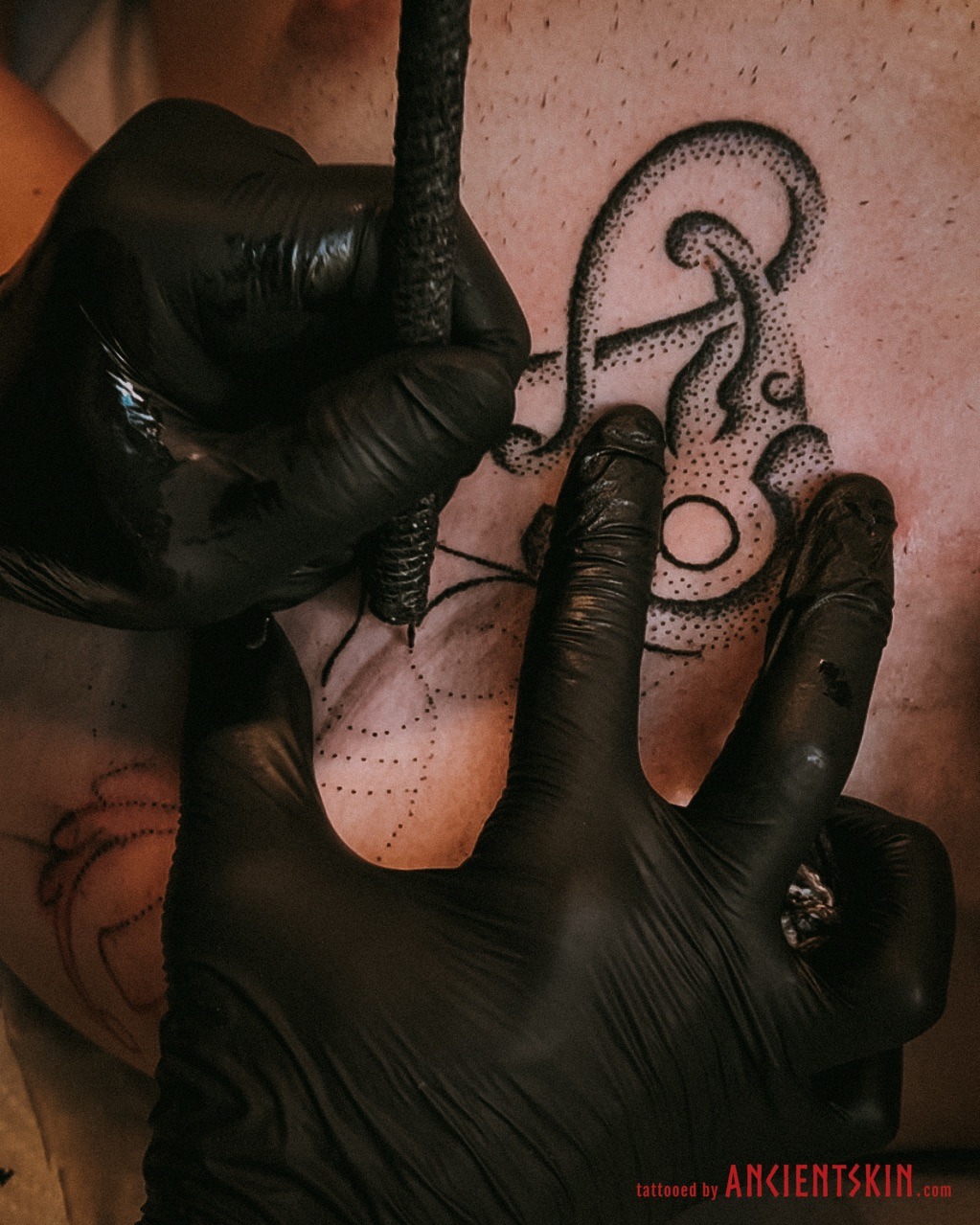
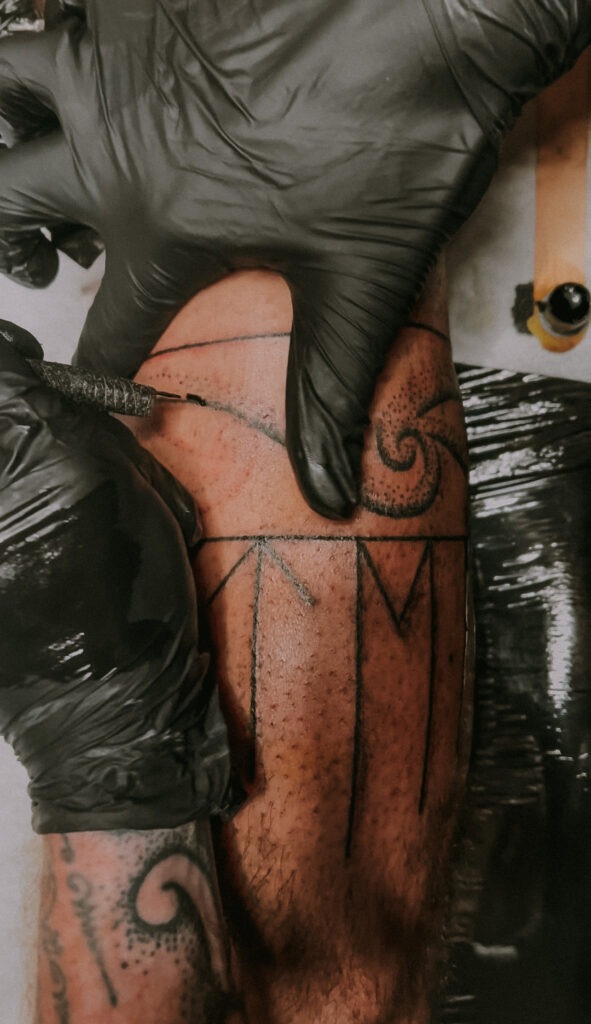
In handpoke tattooing, the needle is guided entirely by hand, without the use of an electric tattoo machine. Each dot I do is made individually, introducing a small amount of pigment into the skin. Only as much as needed to create the picture. Through the accumulation of these individual points, lines, textures, and solid areas are gradually formed into the finished tattoo. The process is slow, deliberate, and highly tactile and even meditating. Every single dot is placed consciously and has its purpose.

Ancientskin Handpoke Tattooing

Machine tattooing, by contrast, uses a mechanically driven needle that moves rapidly in and out of the skin. Depending on the machine, its configuration, and the technique being used, the needle may move at a very high frequency, allowing hundreds of individual punctures to be made within a short period of time. In handpoke tattooing, there is no continuous mechanical movement. The rhythm of the work is instead determined entirely by the hand of the tattooer.

This difference creates a distinct working process. Handpoke tattoos can require more time to complete, particularly when working with larger or highly detailed designs. At the same time, the slower pace allows the tattooer to directly control every individual puncture, including its placement, angle, depth, and spacing. For many practitioners, this direct relationship between hand, needle, and skin is an essential part of the craft.

The way the skin is treated can also differ. Because handpoke tattooing does not involve a rapidly oscillating needle moving continuously across the same area, the mechanical stress placed on the skin can, when performed correctly, be comparatively limited. This should not be understood to mean that handpoke tattooing is painless or inherently gentler in every situation. The condition of the skin after a tattoo depends on many factors, including needle choice, technique, depth, pressure, the number of passes over an area, the design itself, and the individual’s skin. Professional tattooing therefore requires careful technique and a thorough understanding of how the skin responds and heals, regardless of the method used.

Historically, handpoke tattooing is perhaps better understood not as an alternative to tattooing, but as a continuation of one of its original forms. The materials, hygiene practices, and tools used today are fundamentally different from those available to tattooers centuries or millennia ago. The underlying principle, however, remains similar, because the pigment is placed into the skin through repeated, controlled punctures made by hand.

The term “stick and poke” is sometimes used informally to describe this method. While widely understood, it is a more casual and negative expression and does not fully reflect the craftsmanship, respect or historical depth of the practice. Terms such as “handpoke,” “hand-poked tattooing,” or “machine-free tattooing” more accurately describe the technique itself.

Handpoke tattooing is not machine tattooing performed at a slower speed. It is a distinct way of working in which the entire process is governed by the movement of the hand. Every dot, line, and passage of pigment is created individually. The slower rhythm becomes part of the method itself, connecting contemporary tattoo practice with a tradition that predates the electric tattoo machine by thousands of years.

Modern handpoke tattooing combines an ancient principle with contemporary materials, knowledge, and hygiene standards.

Nordic & Historical Handpoke Tattooing
Colin Dale | Skin & Bone Tattoo Shop in Copenhagen, Denmark

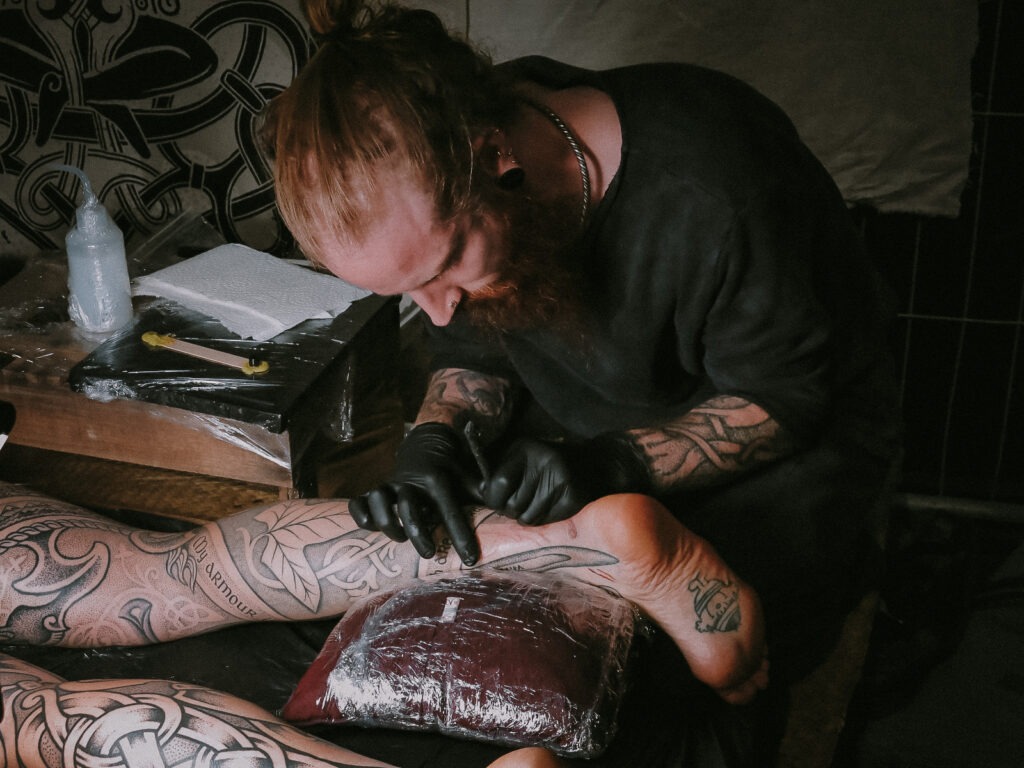
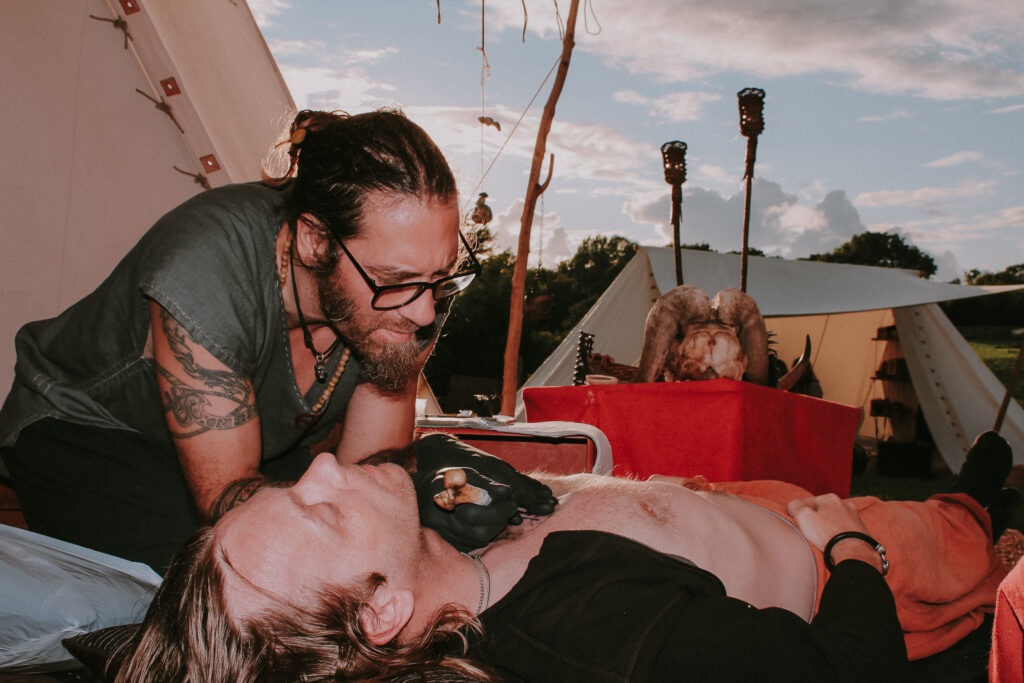
This is Colin Dale | Skin & Bone tattooing on the Historical Market in Copenhagen.

Ancientskin-Handpoke-Nordic-and-historical-tattooing
Picture © Aron Lux
Categories
Norse History Hub

The Viking Tattoo

Did Vikings have Tattoos?

There is some evidence that Vikings may have had tattoos, although there is no archaeological proof that can confirm how common they were. One of the most important written sources is the account of Ahmad ibn Fadlan, an Arab traveler who encountered a group of Rus people in the early 10th century.

Ibn Fadlan described these people as being tall and having designs covering their bodies. He compared the markings to trees and other images and said they extended from their fingertips up toward their necks. Because the Rus were Scandinavian traders and warriors who traveled through Eastern Europe, this description is often used as evidence that at least some Vikings may have practiced tattooing.

However, Ibn Fadlan did not specifically call these people „Vikings“ and his description does not prove that all Vikings had tattoos. The exact identity of the Rus and the meaning of their body markings are also subjects of historical discussion.

Therefore, the most accurate conclusion is that tattoos among some Viking-age Scandinavians are possible and may be supported by Ibn Fadlan’s account, but there is not enough evidence to say that tattoos were common among all Vikings. When we speak of Viking Age art today, we often do
not think of a specific style, but rather generally of
intertwined bands and animal beings. Although this is
something that almost all Viking Age styles have in common,
from an art-historical perspective, these are several
different stylistic phases.

It is not about copying a historical depiction as accurately
as possible. Such a copy would already be a modern
reconstruction in itself. No artist today can fully bring
back the original perception, the craft environment, or
the cultural context in which these works were created.

We can study the historical forms, understand their
construction, and develop our own visual language from
them. This is exactly what Nordic Tattoo means to me
as well. The work is based on what already exists. On
ornaments in wood and metal, on runestones, on animal
depictions, and on the ways in which lines and forms
developed over centuries. These elements have to be understood
and reassembled. A motif can be historically inspired
without itself being a historical motif.

This essentially also corresponds to the way the art of
that time was created. They too drew upon forms that
were already known and developed them further. Influences
from elsewhere were taken up and adapted to their
own visual world. Because tradition did not mean standing
still, but further development.

A modern Nordic tattoo can therefore never truly be
“Viking Age.” It is created in another time and under
completely different conditions. But it can be created
from the same attitude. Namely, to understand existing
forms and use them to create something new and independent
that carries the old spirit within it and brings it
into the present. Everything we develop from it today is
a modern interpretation.

Categories
The History of The Runes

The History About The Runes

Many theories have been proposed about who created the runes. Some of these theories have more supporters than others, but they all share one thing in common: none of them can be proven with complete certainty. No runic inscriptions, as we recognize the runes today, can be dated with certainty to a time before 200 AD.

I choose to follow the theory that the runes were created around 100–200 AD among the Goths or other Germanic tribes living in an area north of the Black Sea. The runes may have been influenced by the Greek and Latin alphabets. There are many arguments that support this theory.

Later, the runes spread throughout central and northern Europe as these tribes migrated. They were used by the Goths, Herulers, Germans, and Frisians in southern and central Europe, as well as by the Angles and Saxons in the west. In the north, they were used by the Norwegian, Swedish, and Danish people, as well as their counterparts in Iceland and Greenland and the Sami of Lapland (northwestern Russia and northern Sweden, Norway, and Finland).

By around 300 AD, the runic alphabet was the only alphabet used in Scandinavia. However, in central Europe, the runes gradually fell out of use because of the growing popularity of the Latin alphabet, which spread along with Christianity.

Runes could be written from left to right or from right to left. They could also be written with the first sentence going from right to left and the second sentence from left to right, a style known as boustphedon. In addition, runes were sometimes written as a mirror image („venderuner“), upside down („stupruner“), or joined together („bindrunes“), such as the Norwegian Æ (A+E).

A single rune could also represent two runes. For example, the rune „FE“ could represent „FE + FE“. Runes were often written as one continuous line of text, without spaces between words or sentences. If the rune master wanted to separate words or sentences, he used a symbol similar to the letter X, or one, two, or three dots placed above one another. For example, when using two dots, he might write: „I:MAKE:SPACE:WITH:TWO:POINTS“.

There were no lowercase runes; only uppercase runes existed. There were also no strict limits on the format in which runes could be written. They could be written in many different directions and on almost any type of common material. They could be used as beautiful decorations or as hidden magical formulas.

When runes were carved into stone, the rune master created the lines by carving many individual points close together until a complete line was formed.

Four other theories about the runes

1) The Crete Theory

According to the first theory, the runes were introduced to Scandinavia during the same period when the well-known spiral ornaments were introduced from Crete, approximately 1800–400 BC. This theory suggests that the Goths were already familiar with the art of runes before they left Scandinavia, sometime between 200 BC and 200 AD. However, this theory is not as widely accepted.

2) Kjell Aartun’s Theory

Kjell Aartun is a doctor of philosophy and language researcher. In his book RUNER i kulturhistorisk sammenheng, En fruktbarhetskultisk tradisjon (Pax Forlag, Oslo 1994), he writes that he has proven that the runes were not inspired by the Greek and Latin alphabets.

Instead, he argues that the opposite is true. According to his theory, the Norwegian runes are identical to runes that were used in Semitic language areas, such as Trojan Asia Minor and Canaan (Palestine), as far back as 2000 BC.

In Aartun’s view, the runes were one of several oriental writing systems that formed the basic foundation from which the Greek and Latin alphabets later developed. He also writes that he can prove that the earliest Norwegian runic inscriptions were written in a Semitic language. He refers to known cult-based erotic texts, many of which contained sacred depictions of the act of making love.

According to Aartun, new archaeological discoveries show that many people from the Mediterranean region, especially the Cretans (who were Semitic), frequently traveled north on trading journeys. He argues that during the Migration Period, many Semitic-speaking people came to Norway.

Aartun writes that this conclusion is supported by actual facts referred to by Snorri when he says: „these Asians was called aeser(…) in the northern countries the Asians spread so much that their language was the common language in all these countries.“

Kjell Aartun’s theories are not accepted by authoritative Norwegian rune-ologists. However, his theory does have supporters, including some on the Internet site about Blekinge’s Most Ancient Runic Inscriptions.

3) Turgay Kürüm’s Theory

Turgay Kürüm of Turkey writes on his webpage that the purpose of his article is to draw readers‘ attention to the idea that the Futhark alphabet has the very same origin as the ancient Turkish inscriptions of the Gokturk alphabet.

4) The South-Scandinavian Theory

The fourth theory states that the runes created in South Scandinavia during the 300s AD were inspired by the Latin alphabet, but were adapted to a Scandinavian cultural context.

South Scandinavia was a center of runic activity in ancient times.
Categories
Viking Symbols & Artefacts - Ancient Nordic Tattoo inspiration

Gjermundbu Sword

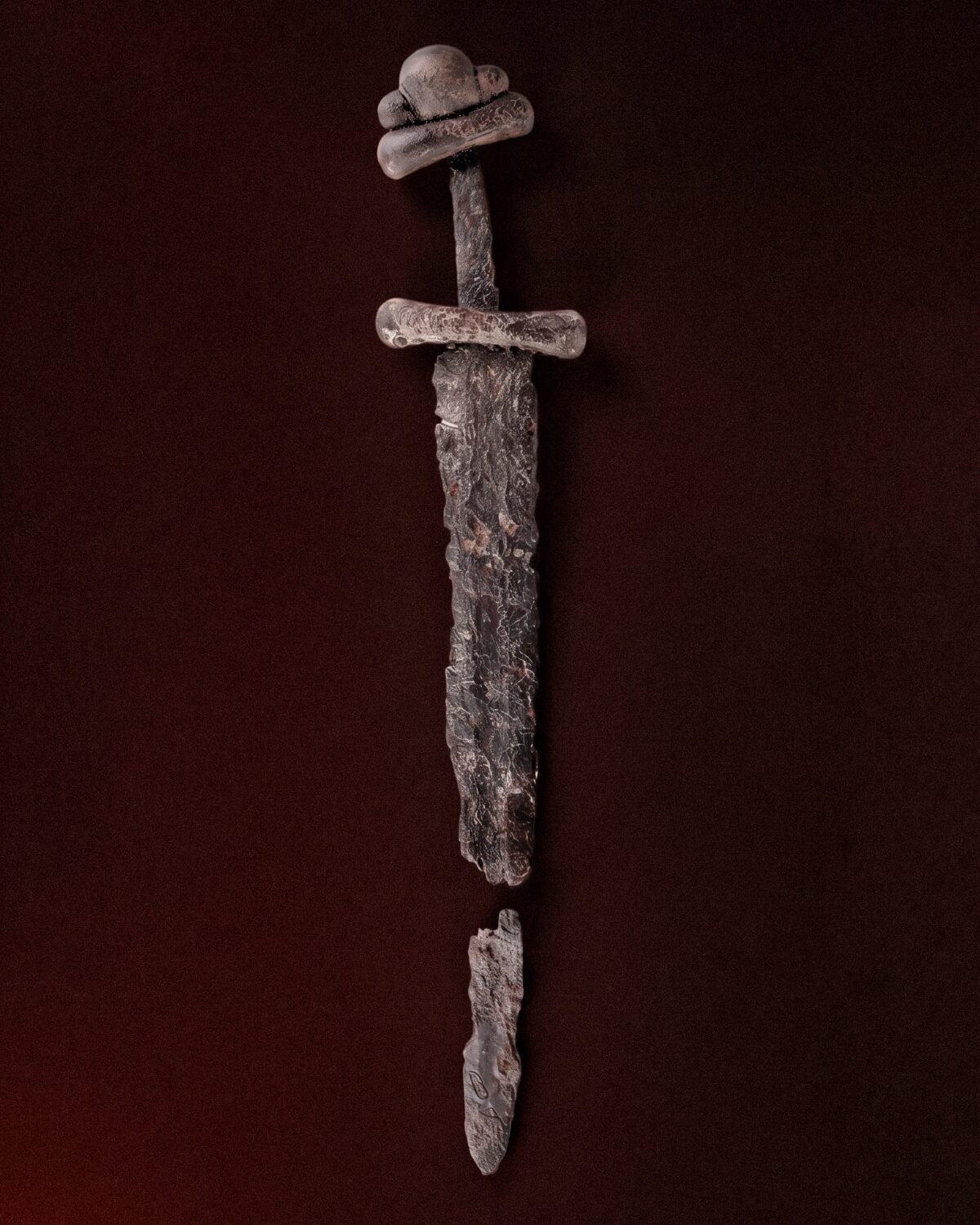
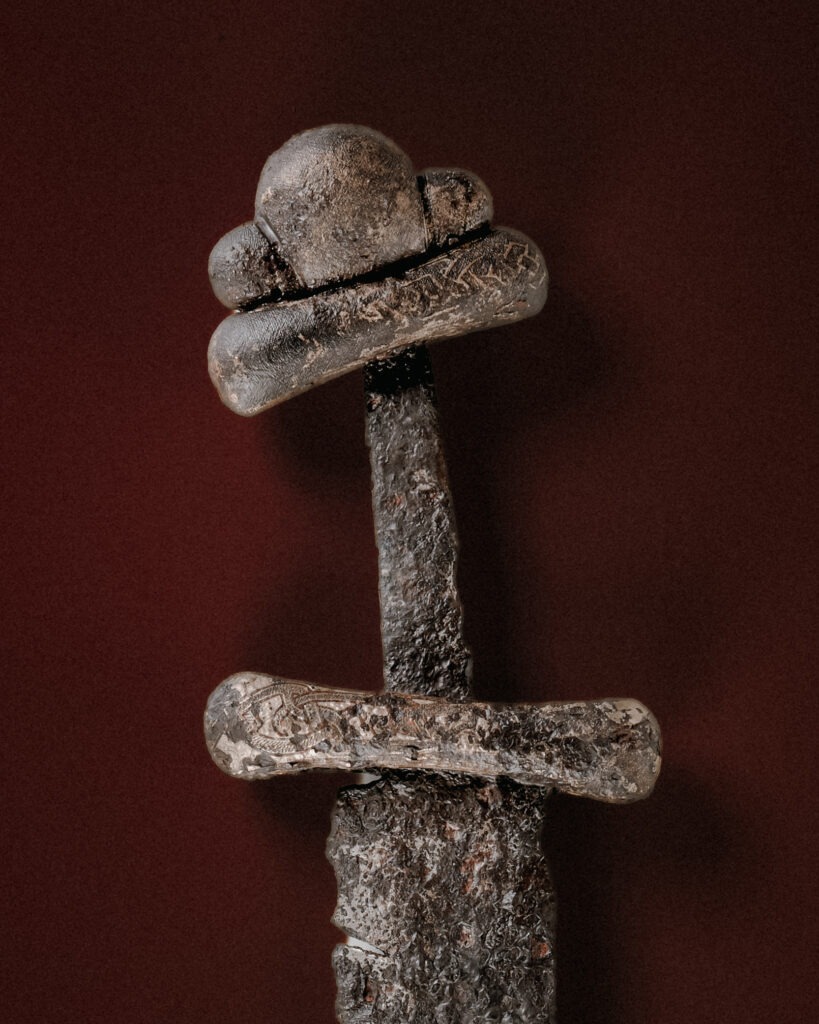
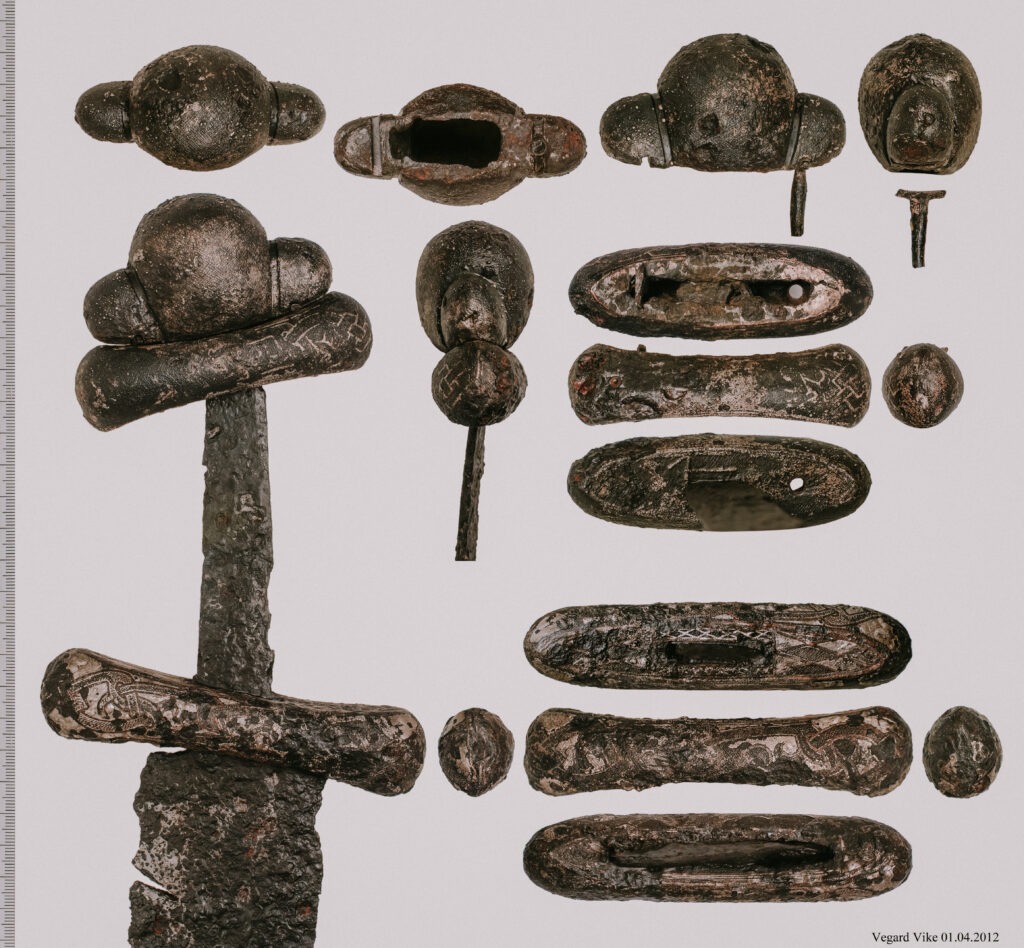
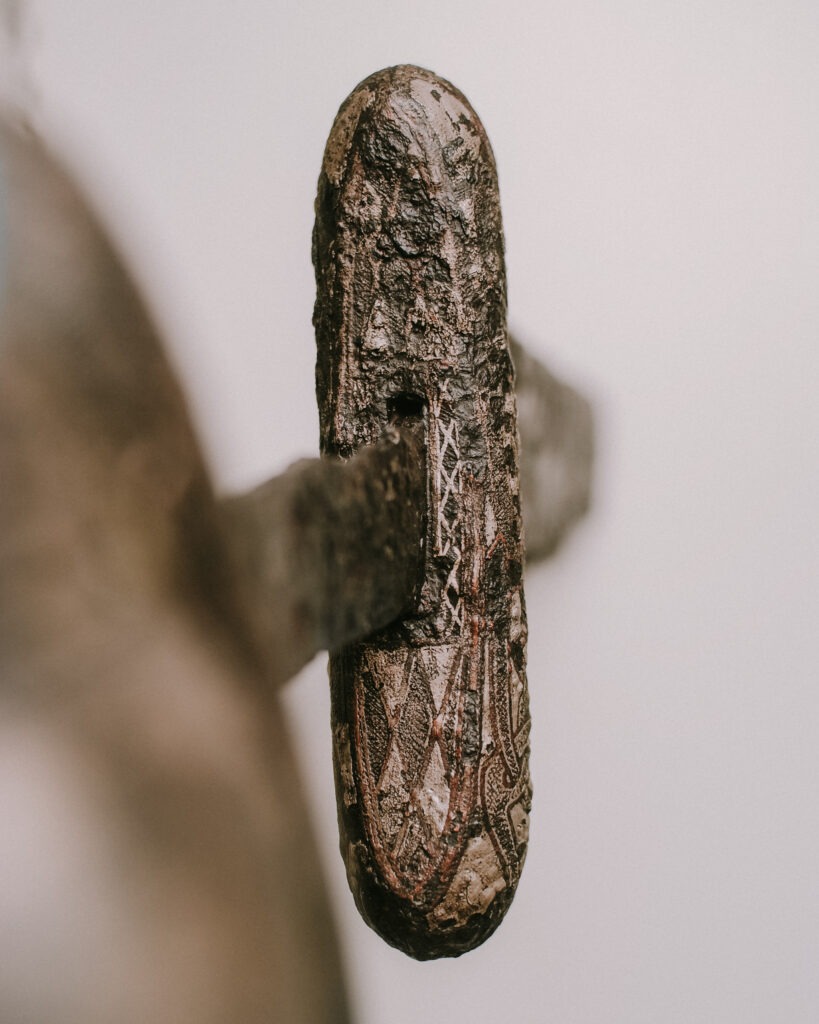
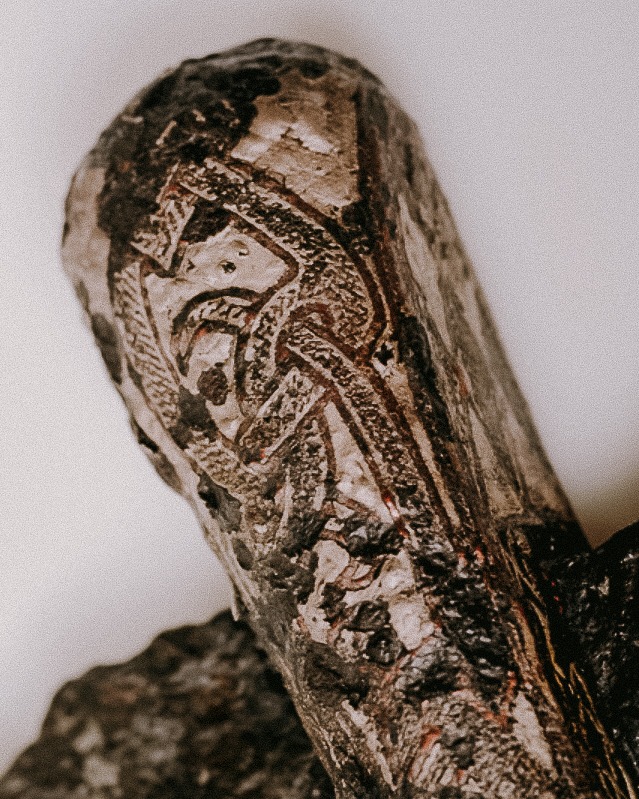
Gjermundbu Sword – I really love to go through the archives of museums to find all the info you get from finds like this sword. Look at the details. The Gjermundbu Sword is a double-edged iron sword with inlaid silver decoration, Petersen type R (J. Petersen 1919). The sword closely resembles Rygh 504. The pommel is five-part, forged from several pieces; the two outermost parts form the snouts and heads of two animal heads facing away from each other. Two through-going rivets are visible beneath the animal heads in the X-ray photograph.

The transitions between the pommel sections, as well as the transition between the pommel and the upper guard, are marked with braided and twisted silver wire. The sword pommel is densely decorated with inlaid, dotted bands forming interlacing patterns and spirals. The decoration on the upper and lower guards consists mainly of multi-line, dotted bands with spiral ends and similar motifs.

On the upper side of the lower guard, two intertwined serpent figures can be seen, one on each side of the grip. On the underside, there is a simple leaf motif on each side. The silver inlay is partially melted away, particularly on one side of the lower guard.

The blade itself is forged from longitudinally welded strips, with a relatively thin blade and a shallow, broad fuller. The sword is illustrated in Sørheim, H. 1997, figs. 12–14.

Viking Age grave find from Gjermundbu (farm no. 105, property no. 1), Haug parish, Norderhov parish district, Buskerud. Grave I.

The find was reported to the University’s Oldsaksamling (Collection of Antiquities) on 30 March 1943. Curator Sverre Marstrander and assistant Charlotte Thomas were immediately sent to the site. On the basis of Marstrander’s report of 17 April 1943, the following may be stated: The find was made during the excavation of a mound. The Gjermbu or Gjermundbu farms are situated high in the hills at the upper end of Haugsbygd, with extensive views over the Ringerike plain and westward towards the mountains of Telemark.

Total sword length: 93.3 cm
Blade length: 78.5 cm
Guard lengths: 13.9 and 8.5 cm
Pommel height, including the upper guard: 4.7 cm
Maximum blade width: 6.3 cm
Blade thickness: 0.5 cm

Pictures: Kulturhistorisk Museum; Unimus Portalen – unimus.no
Gjenstand: C27317; Bestillingsnr: Cf53886_453_C27317_a
Fotograf: Vegard Vike; Helgeland, Kirsten Lisens: CC BY-SA 4.0

Viking Age grave find from Gjermundbu (farm no. 105, property no. 1), Haug parish, Norderhov parish district, Buskerud. Grave I. The find was reported to the University’s Oldsaksamling (Collection of Antiquities) on 30 March 1943. Curator Sverre Marstrander and assistant Charlotte Thomas were immediately sent to the site. On the basis of Marstrander’s report of 17 April 1943, the following may be stated: The find was made during the excavation of a mound. The Gjermbu or Gjermundbu farms are situated high in the hills at the upper end of Haugsbygd, with extensive views over the Ringerike plain and westward towards the mountains of Telemark.
Categories
Nordic Tattoo

Tullstorpstenen Wolf Tattoo

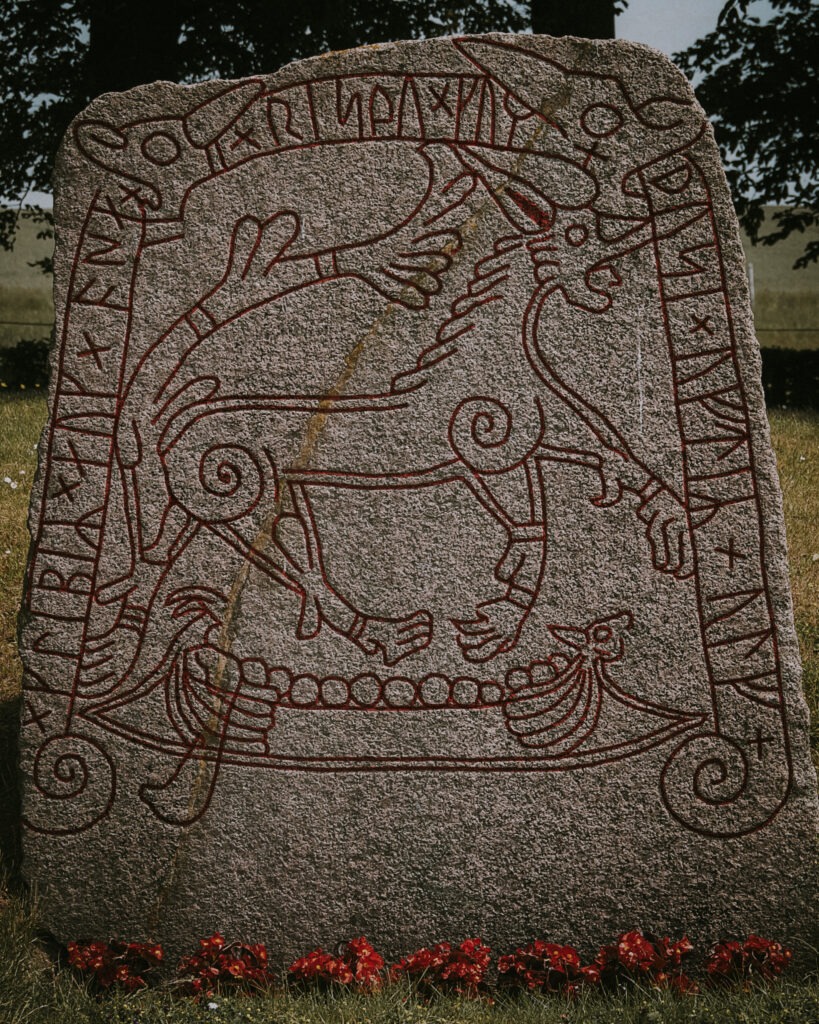
Handpoked Wolf, Runes by machine. This nordic tattoo was made for a lovely guy from france coming all the way over to sweden to connect with his roots. Half swedish, half french – so we decided to get inspired by a famous runestone, which propably depicts a wolf, maybe Fenrir. The Tullstorpstenen. The inscription on the Tullstorp Runestone consists of runic text on a serpent band that frames a central image consisting of a ship and a beast, which has been described as being a wolf. The stone is granite and 1.7 meters in height, and the inscription is classified as being carved in runestone style Pr1, which is also known as Ringerike style.

The Tullstorp Runestone is a Viking Age memorial runestone, listed as DR 271 in the Rundata catalog, that is located in Tullstorp, which is about twenty kilometers east of Trelleborg, Skåne County, Sweden, and in the historic province of Scania.

🇸🇪 Tullstorpstenen, med signum DR 271, är en runsten som står på Tullstorps kyrkogård i Tullstorps socken och Trelleborgs kommun i Skåne. Dess ursprungliga plats är okänd.

Picture of the runestone: Sven Rosborn Creative Commons Attribution-ShareAlike 3.0 Unported – Thank you!

Categories
Nordic Tattoo

Nordic Seal and Jormungandr

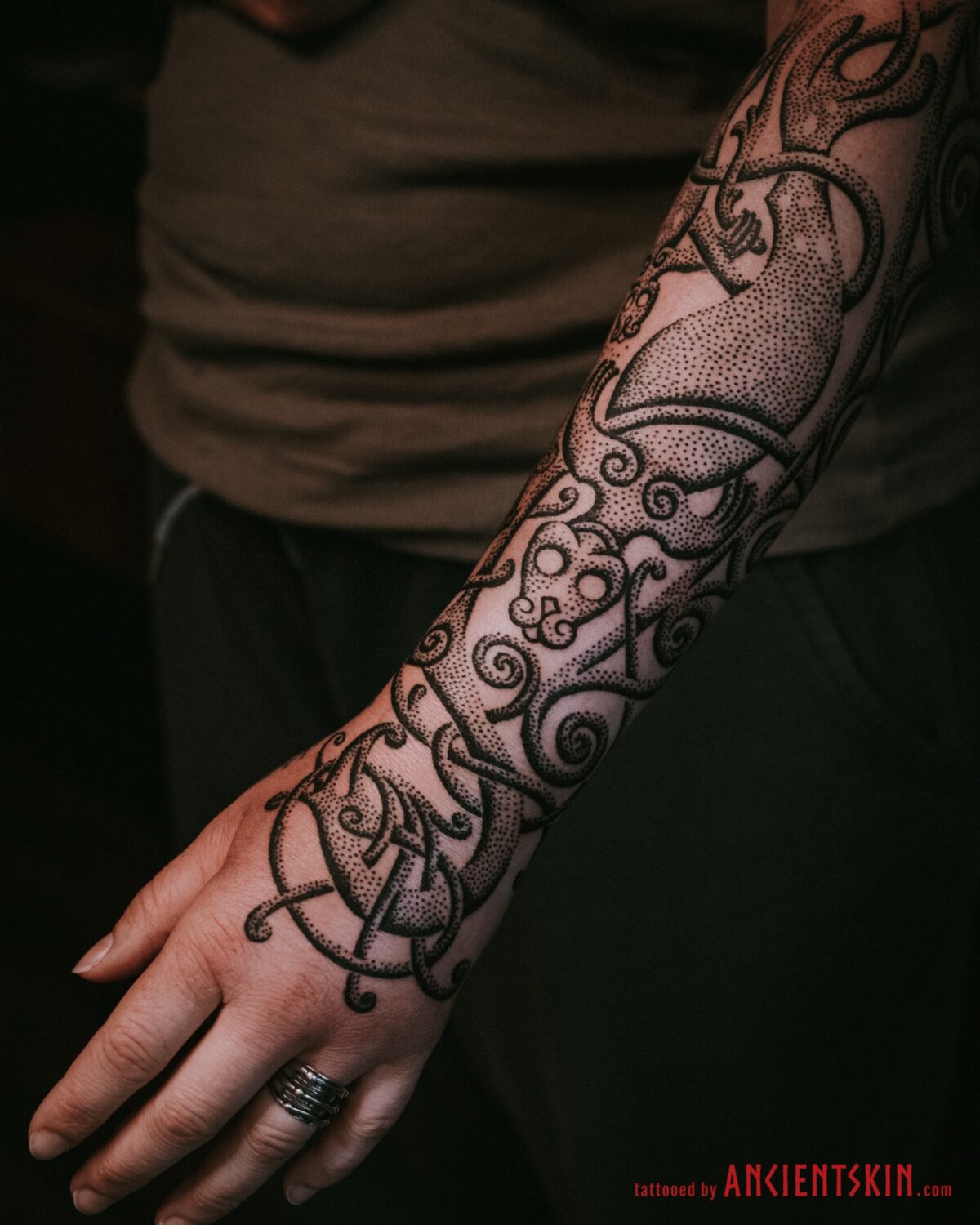
Nordic tattoo in Sweden – Jormungandr and a Seal – A sleeve dedicated to Rán, the goddess of the sea. In Norse mythology, Rán is a goddess and personification of the sea. Rán and her husband Ægir, a jötunn who also personifies the sea, produced together nine daughters who personify the sea waves. Rán also has a son Snær who personifies the snow. Rán may also be the mother of the beautiful jötunn Gerðr, wife of the god Freyr. The goddess is frequently associated with a net, which she uses to capture sea-goers. According to the prose introduction to a poem in the Poetic Edda and in Völsunga saga, Rán once loaned her net to the god Loki.

Categories
Nordic Tattoo

Jelling Style Wolf with Mushrooms

Jelling Style (900—975) Wolf with Mushrooms. The Viking art style Jellinge is a phase of Scandinavian animal art that took place during the late 10th century. Bridging the earlier Borre style with the later Mammen style, it is characterized by ribbon-like stylized animal motifs and band-shaped bodies of animals. It was originally applied to a variety of objects in Jelling, Denmark, such as Gorm’s Cup by King Gorm and Harald Bluetooth’s great runestone, but more recently the style is included in the Mammen style.

Nordic tattoos inspired by the past, nature, mushrooms, folk art, symbolism, runestones and nordic mythology. I am based in Sweden, Västra Götaland. Visit us in Sweden!

Categories
Guestspots & Conventions

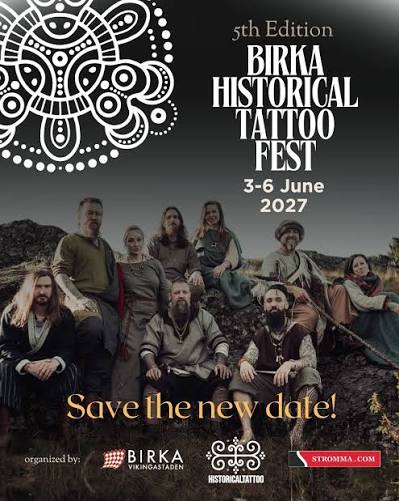
Historical Tattoo Fest Birka 2027

You will find me tattooing in Sweden 03-06 June 2027 | Nordic Tattoo | Viking Art | Historical * Nordic * Celtic * Baltic * Ornamental Tattoo Convention. | Birka, Sweden: @birkavikingastaden

Ancientskin at the Birka Historical Tattoo Fest – Handpoke Nordic Viking Art

Ancientskin brings the ancient tradition of handpoke tattooing to the Birka Historical Tattoo Fest in Sweden, where history, craftsmanship, and Nordic culture come together in a unique atmosphere. Inspired by the artistic heritage of the Viking Age.

Working primarily with the traditional handpoke technique, each tattoo is created slowly and deliberately, one point at a time. Unlike modern machine tattooing, handpoke allows for a quieter and more intimate process. Every mark is placed by hand, creating a distinctive texture and character that reflects the handmade nature of historical art.

Ancientskin’s Nordic-inspired designs draw from the visual language associated with Viking Age Scandinavia: powerful animals, intertwined forms, symbolic patterns, ancient ornamentation, and elements inspired by archaeological discoveries and historical artwork. Motifs may evoke wolves, ravens, serpents, bears, trees, warriors, protective symbols, or the flowing geometry of Nordic ornament.

The Birka Historical Tattoo Fest provides a particularly meaningful setting for this work. Birka, located on the island of Björkö in Lake Mälaren, was one of the most important trading centres of the Viking Age. For centuries, people, goods, ideas, and artistic influences travelled through this place. Today, the historical landscape offers a powerful backdrop for exploring ancient-inspired craftsmanship.

It is about approaching historical inspiration with respect while creating something personal for the wearer. Each tattoo becomes an individual piece of living art influenced by archaeological heritage, Nordic aesthetics, and the relationship between tradition and modern identity.

At the festival, visitors can experience the handpoke process up close, discover Nordic inspired tattoo designs, and talk about the history and symbolism behind the artwork. Whether you are looking for a small historical motif or a larger piece inspired by Viking Age aesthetics, Ancientskin focuses on creating tattoos with a strong sense of character, simplicity, and connection.

Ancientskin at Birka is a meeting point between past and present: ancient-inspired art created by hand.

More Information: birkavikingastaden.se

#nordictattoosweden #nordictattoo #nordictattoodeutschland #swedentattoo #nordischetätowierungen

Categories
Guestspots & Conventions

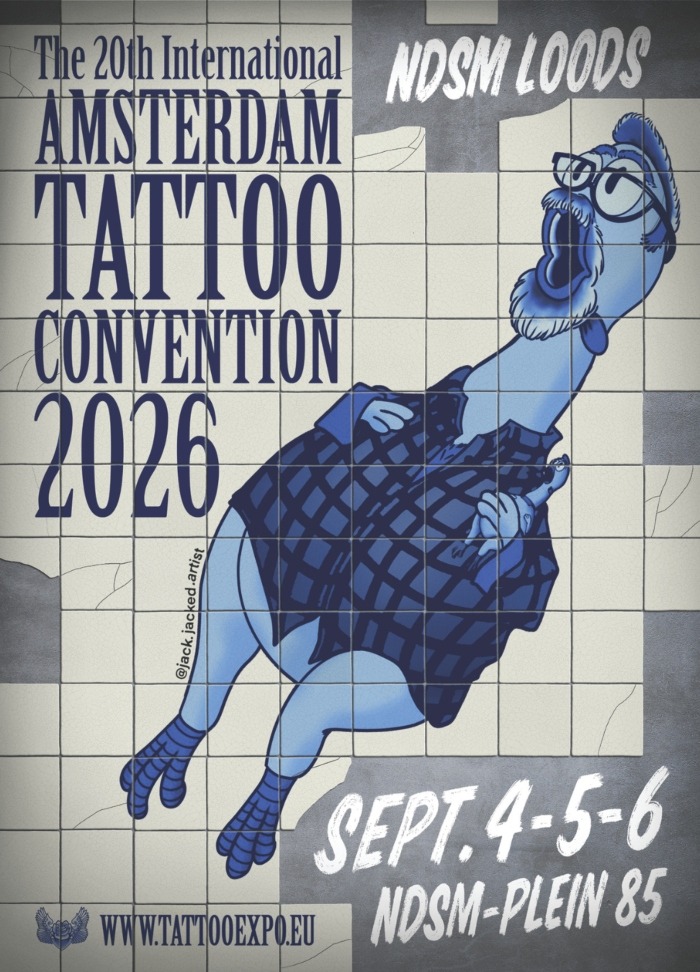
Amsterdam Tattoo Convention 2027

World famous Tattoo Convention 2027 | Amsterdam Tattoo Convention | 03-05 September 2027

NDSM Loods
NDSM-Plein 85
1033 WC Amsterdam

More Information: tattooexpo.eu/de/amsterdam