
Kategorien
Nordic Tattoo

Lunar Year of the Fire Horse

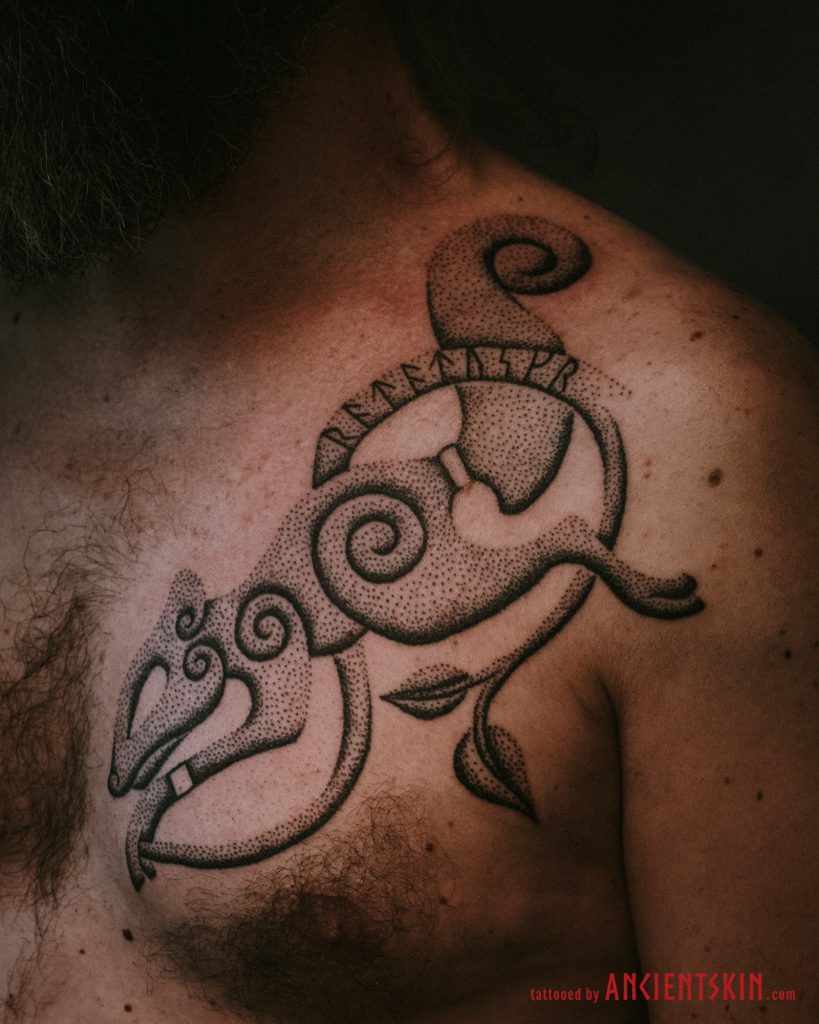
The „2026“ Lunar Year of the Fire Horse, which begins today is a year of swift, transformation and active movement. A very powerful sign and symbol. Its the perfect time to start something new, to left behind whats not serving anymore. It brings me directly to the connection of Raido. The Raido rune (ᚱ) is strongly associated with the horse, representing the journey of life, movement, and the „ride“ of the horse itself. Raido is known as the rune of the journey, representing both physical travel and spiritual, internal, or emotional evolution. It implies taking initiative, gaining control of one’s life, and finding the right path.

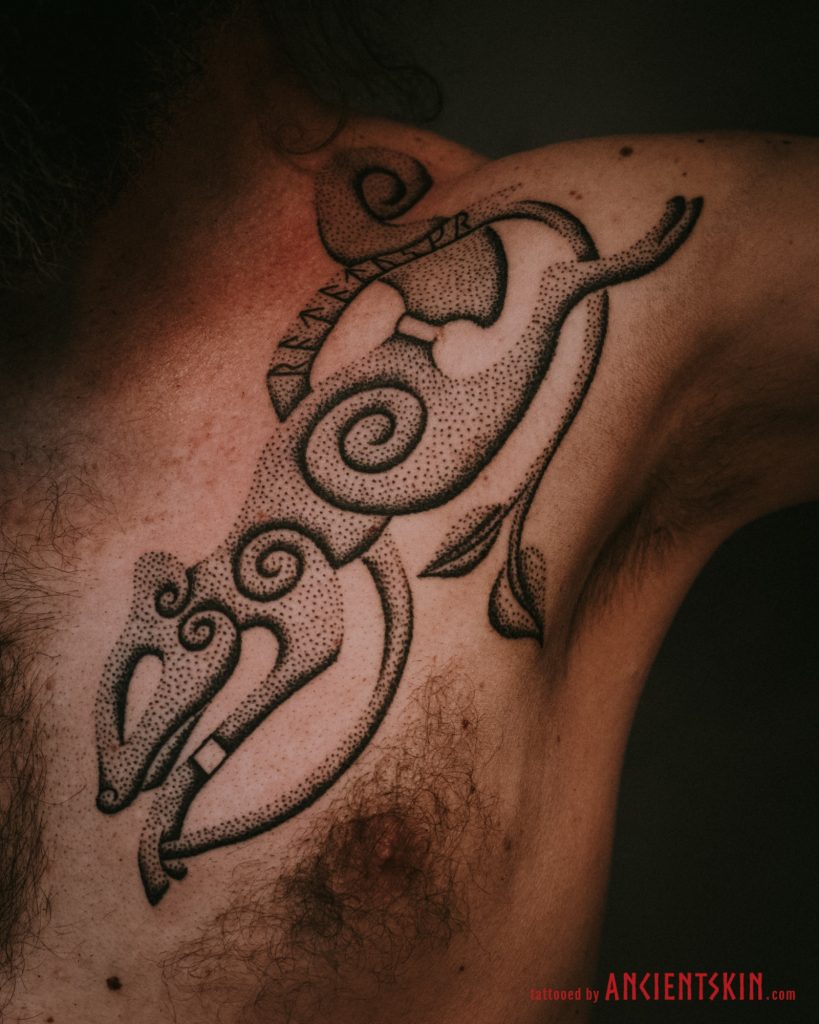
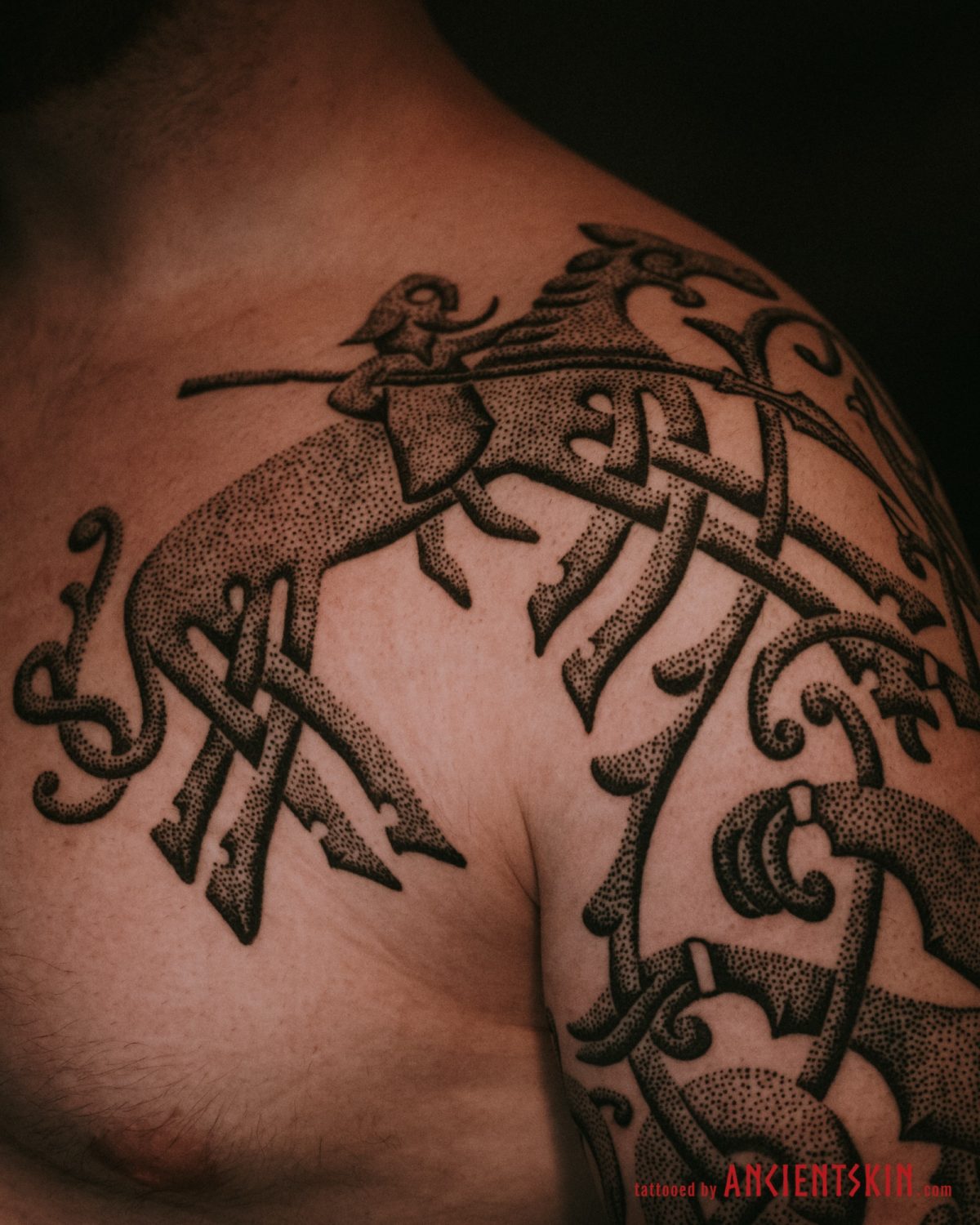
This tattoo shows Sleipnir, the eight-legged horse of Odin. It is inspired by the Tjängvide image stone. This is a Viking Age artifact from Gotland, Sweden, significant for its detailed mythological carvings. Discovery and Location: The stone was discovered in 1844 on a farm in Tjängvide, Gotland, and is now housed at the Swedish Museum of National Antiquities in Stockholm @historiska

Image: Anställd vid SHM, Historiska museet/SHM (CC BY 4.0)

Nordic Tattoo Sweden & Germany — Freehand drawn directly on the skin. Tattooed by hand and machine.

#nordictattoo #horse #firehorse #vikingart #raido
Kategorien
Nordic Tattoo

Carving the body like Runestones

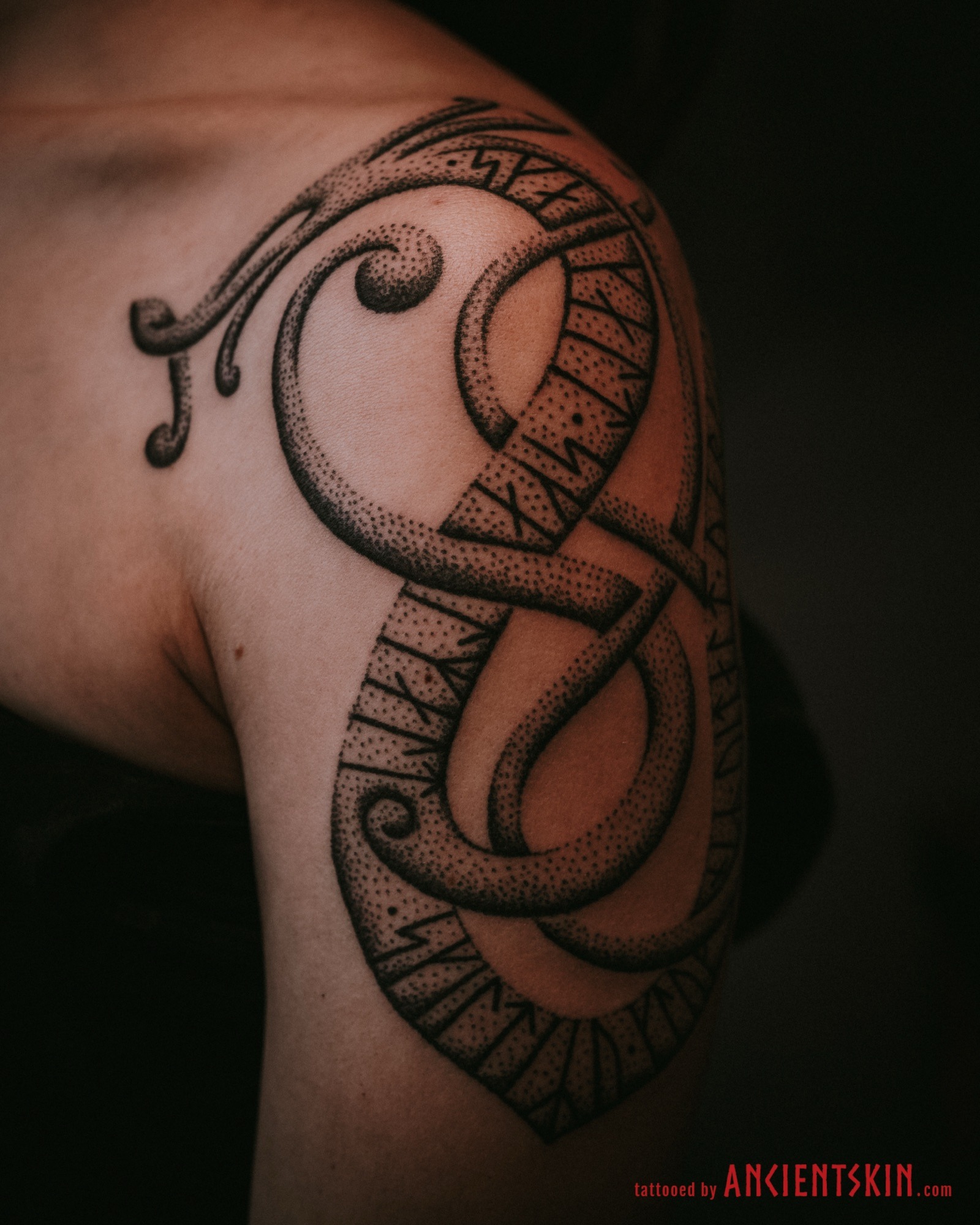
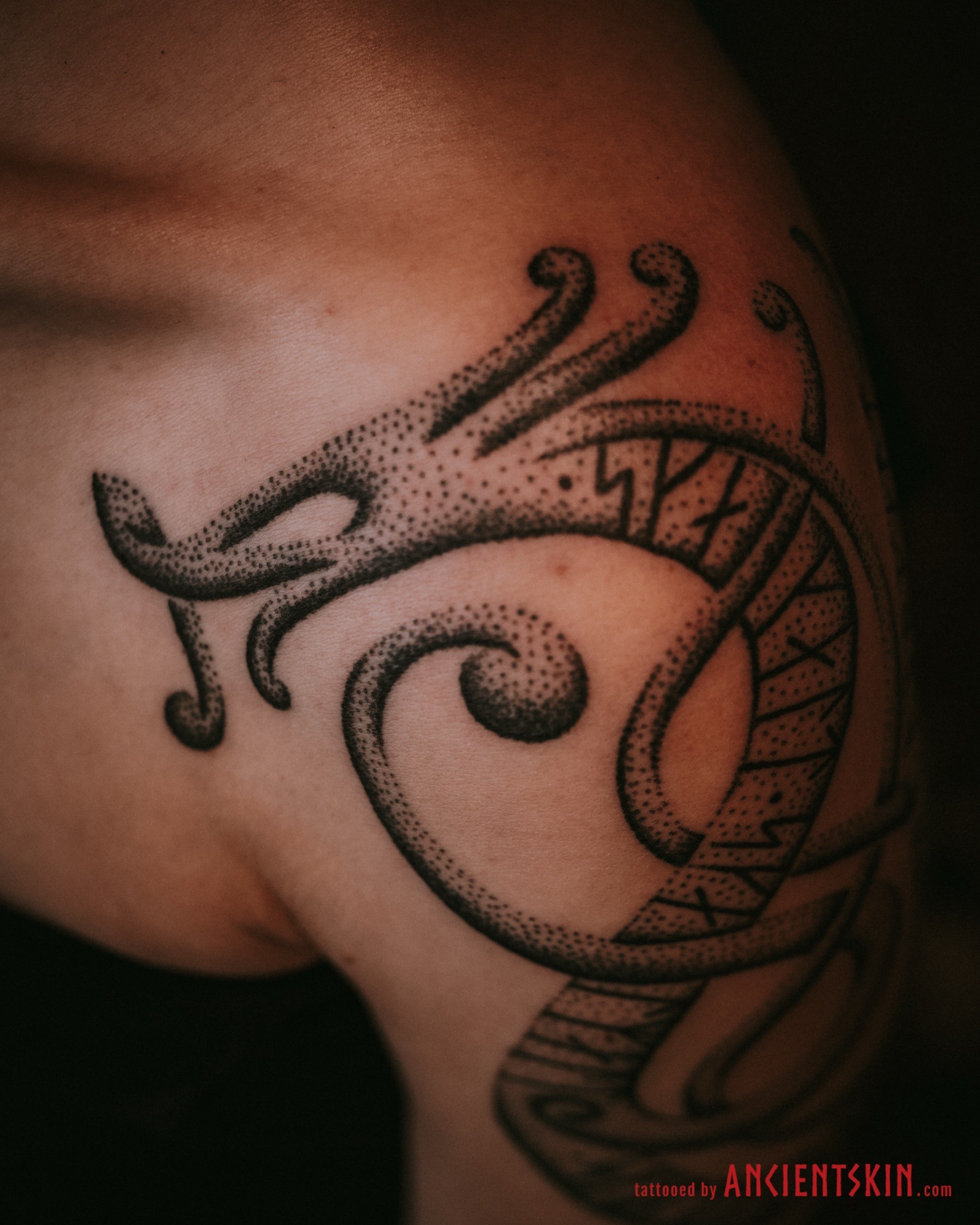
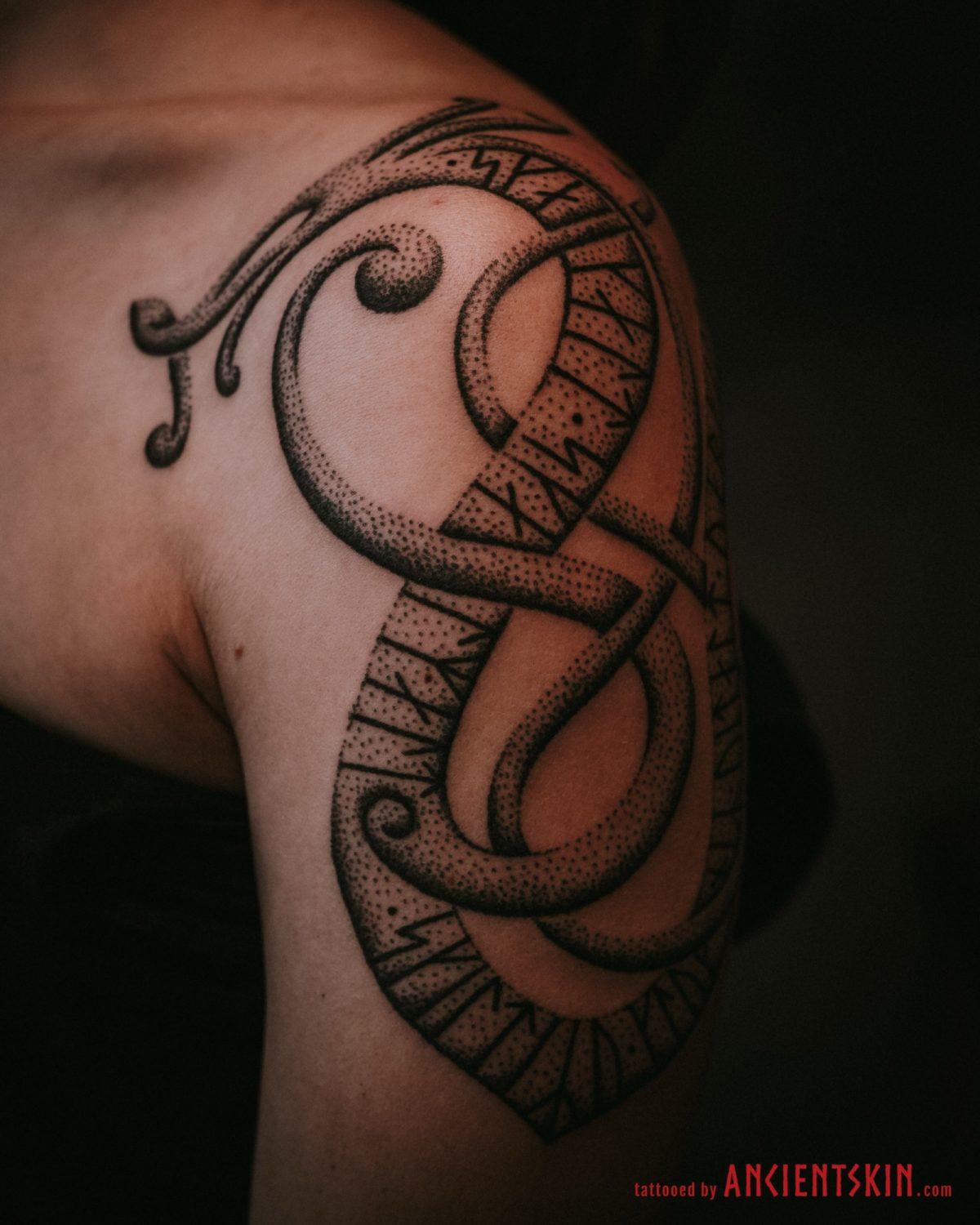
Carving the body like the Runes and Dragons on the Viking Age stones. I do Nordic Tattoo designs, specialized on traditional handpoke, based on the ancient nordic art. I love to do reinterpretations of ancient designs ideas and culturual symbols and bring it into a new context, a very personal meaning and powerful symbol or memory as it was in the past. To honour the value of ourselves and awaken the memories we forgot. Remember the connection to nature.

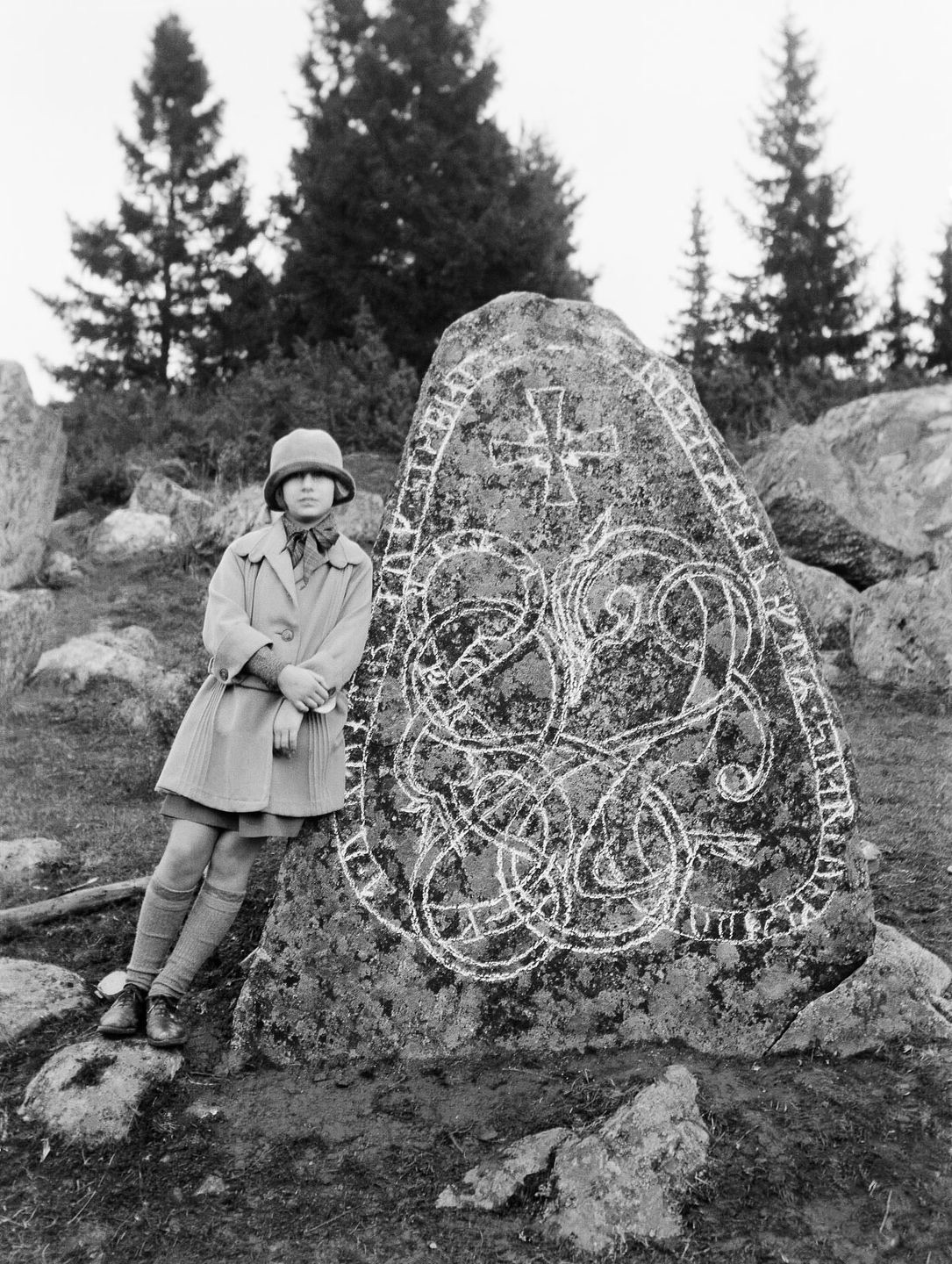
The picture on the last slide is from 1926 and shows a young lady with thr runestone (U1006) in Lejsta, Rasbo, Uppland, Sweden. The inscription reads:

English: Girl at a rune stone (U 1006) in Lejsta. The inscription says: „Vigdjärv and Jorund and Sigbjörn had the stone raised in memory of Svartung, their father“.

Svenska: Flicka vid runsten (U 1006) i Lejsta. Ristningen säger: „Vigdjärv och Jorund och Sigbjörn lät resa stenen till minne av Svartung, sin fader“.

📷 B. Bergman | Swedish National Heritage Board

#nordictattoo #nordicspirit #tatuering #handpoked #nordictattooartist

Kategorien
Nordic Tattoo

Ratatoskr

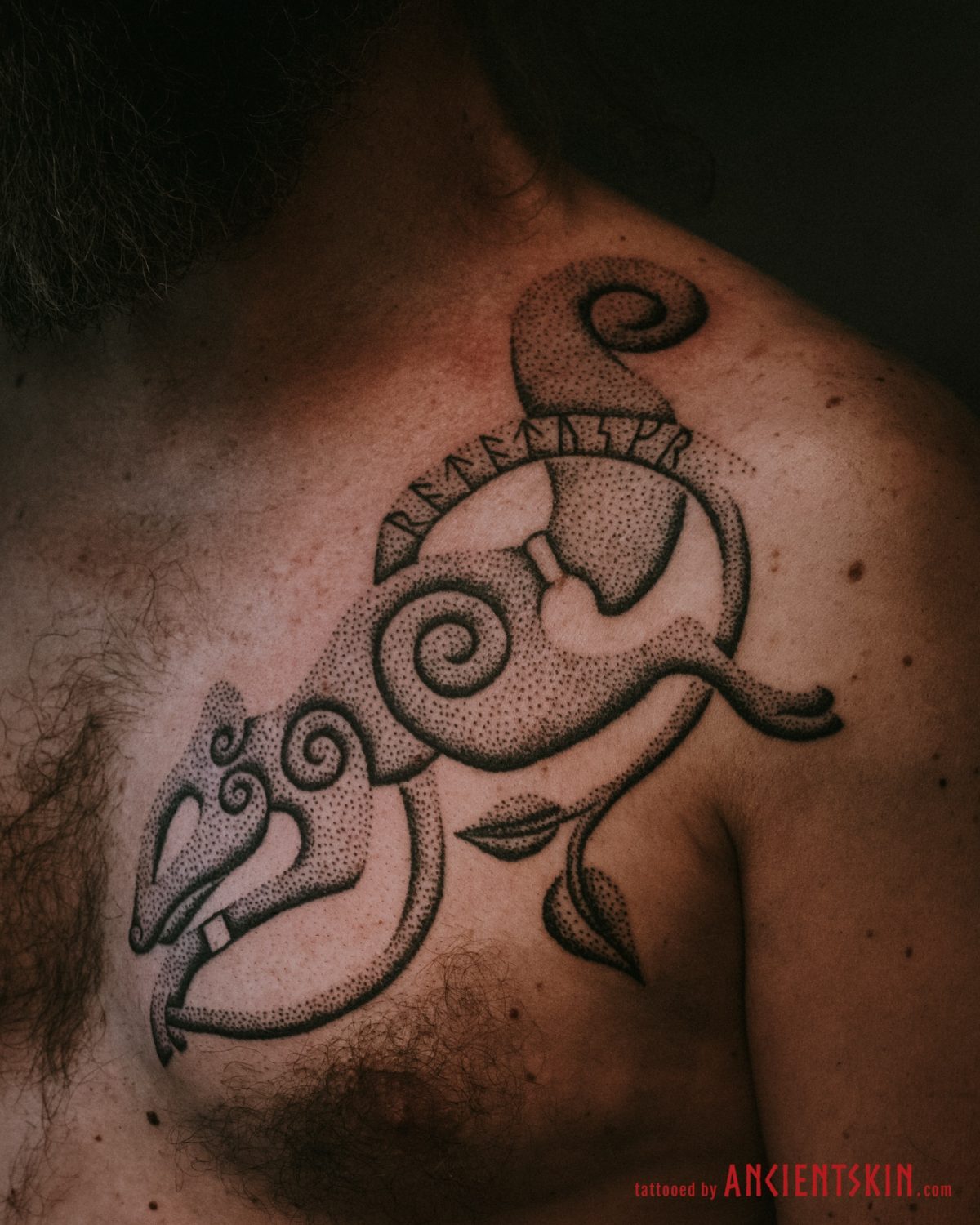
All handpoked and made to move! This is RATATOSKR („drill-tooth“ or „bore-tooth“) is a mischievous red squirrel in Norse mythology who runs up and down the world tree Yggdrasil, constantly conveying malicious gossip, insults, and slander between the eagle at the top and the serpent Níðhöggr below. He serves as a messenger who stirs conflict between the worlds. The squirell is mentioned in the Poetic Edda (Grímnismál) and Prose Edda (Gylfaginning). You see me feeding a representant of this symbol on the last picture.

Handpoked Tattoo, still work in progress as it will be expanded later. Nordic handpoked Tattoo, freehand drawn directly on the skin in my studio in Germany. You will also find me as a resident artist in Sweden (Västra Götaland).

#nordictattoo #nordicmythology #animaltattoo #pagantattoo #nordicspirit

Kategorien
Nordic Tattoo

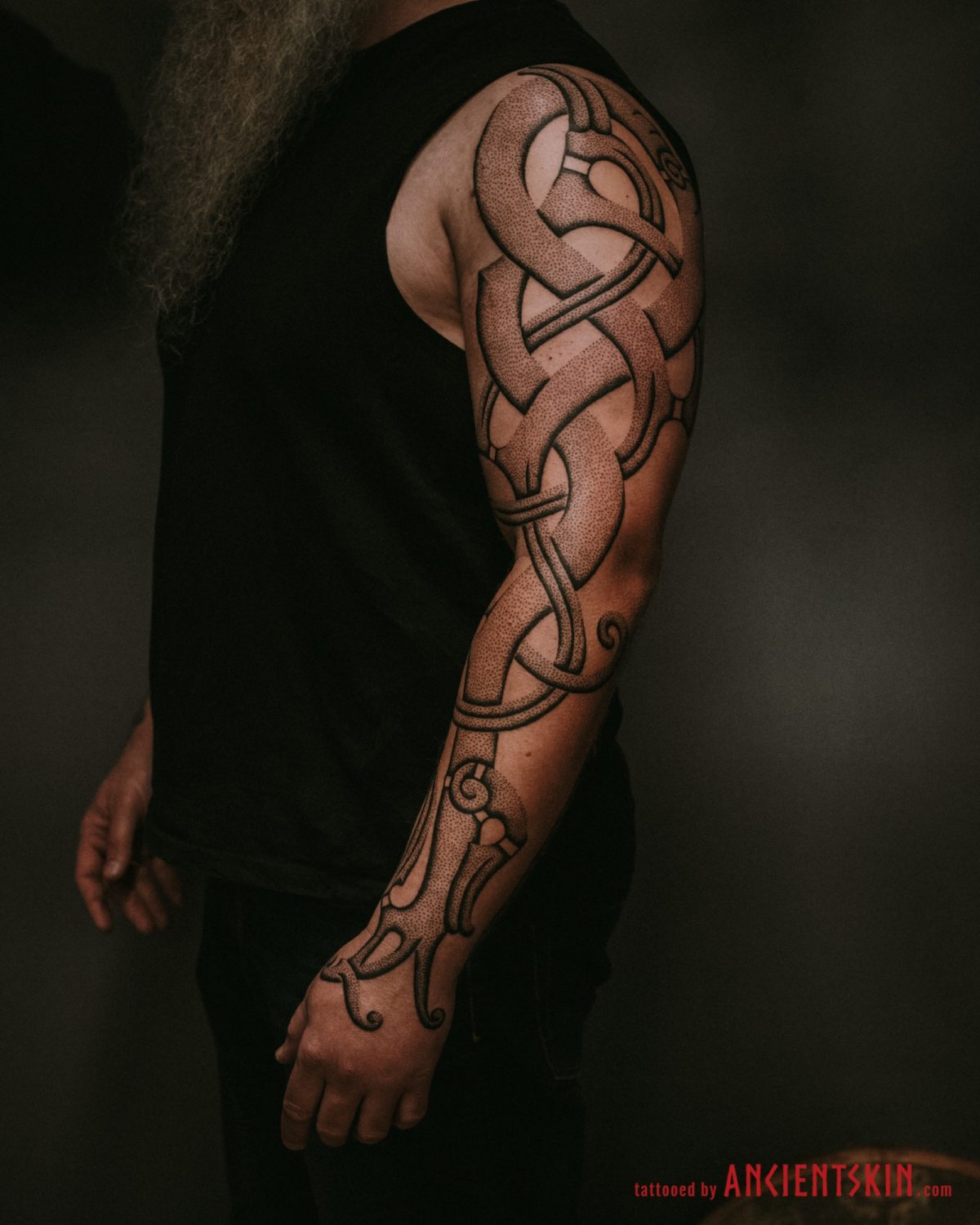
Handpoked Mammen Style (c. 950 – 1030) inspired Nordic Dragon

This handpoked Mammen Style (c. 950 – 1030) inspired Nordic Dragon tattoo was freehand drawn and all handpoked. And the second sleeve of this brave man. The Mammen style grew out of the Jellinge style, and it can sometimes be difficult to tell them apart. The name comes from a small, decorated axe-head, you will find in the last slide here, from a grave in Mammen, Denmark. Recent dendrochronological dating has suggested a date of c. 970 for the grave.

The Axe is inlaid with silver wires: on one side is a foliate pattern. On the other side, which you see on the picture is a bird. The body of the bird is thicker than the ribbon-like bodies of the Jellinge style animals: it is decorated with dots, and there is a large spiral hip. The wings and tail are drawn into long, curving tendrils. At the top of the axe is a human face mask with round eyes, a large nose and a spiral beard.

✍🏻 I have free bookings in Sweden this year. Write me to get your personalized freehand Nordic Sleeve. Handpoked or machine. What‘s your favourite style, figurine from Nordic Mythology or Artefact? Tell me and I make something meaningful out of it for you.

#nordictattoo #tattoo #vikingart #pagan #knotworktattoo

Kategorien
Nordic Tattoo

Jörmungandr and Thor

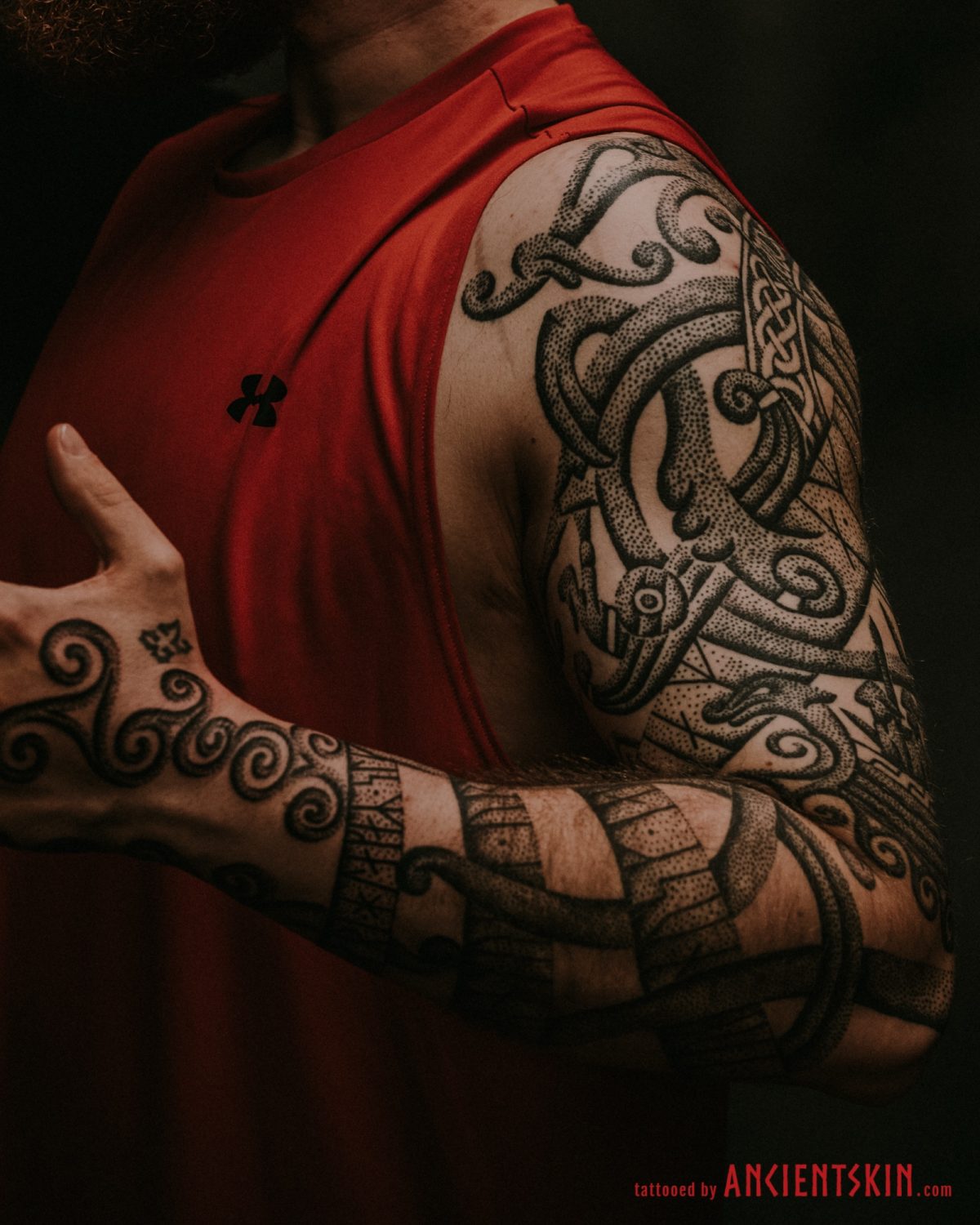
Recently finished this sleeve tattoo. It depicts Jörmungandr and Thor meet again when Thor goes fishing with the jötunn Hymir. This tattoo was done over several sessions. All freehand drawn and inspired by the Gotland picture Stones.

Further in the story Hymir refuses to provide Thor with bait, Thor strikes the head off Hymir’s largest ox to use it. They row to a point where Hymir often sat and caught flatfish and where he drew up two whales. Thor demands to go further out to sea and does so despite Hymir’s protest. Thor then prepares a strong line and a large hook and baits it with the ox head, which Jörmungandr bites. Thor pulls the serpent from the water, and the two face one another, Jörmungandr blowing atter. Hymir goes pale with fear. As Thor grabs his hammer to kill the serpent, the jötunn cuts the line, leaving the serpent to sink beneath the waves and return to its original position encircling the earth. The Eddic poem Hymiskviða has a similar ending to the story, but in earlier Scandinavian versions of the myth in skaldic poetry, Thor successfully captures and kills the serpent by striking it on the head. Thor’s fishing for Jörmungandr was one of the most popular motifs in Norse art. Four picture stones that are believed to depict the myth are the Altuna Runestone and the Ardre VIII image stone in Sweden, the Hørdum stone in Denmark, and a stone slab at Gosforth, Cumbria by the same sculptor as the Gosforth Cross. Many of these depictions show the giant cutting the fishing line; on the Altuna stone, Thor is alone, implying he successfully killed the serpent. The Ardre VIII stone may depict more than one stage in the events: a man entering a house where an ox is standing, two men leaving, one with something on his shoulder, and two men using a spear to fish. The image on this stone has been dated to the 8th to 10th century.

Nordic Tattoos in Sweden. Art inspired by ancient artefacts, Runestones, symbols or stories from Nordic Mythology.

#nordictattoo #swedentattoo #tattoo #nordicmythology